
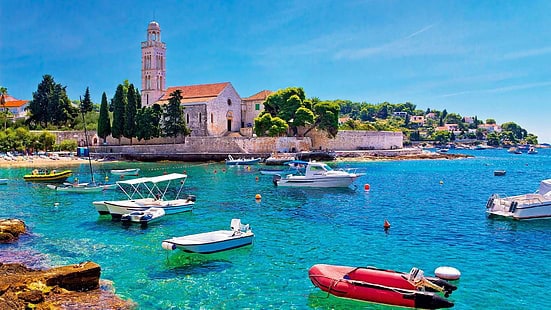
There is a harbour in the northern Adriatic that has no superyacht infrastructure to speak of. No marina with shore power connections rated above 100 amps. No yacht chandler within 40 kilometres. The nearest airport with private jet handling is an hour and twenty minutes away on roads that were not designed with transfer vehicles in mind.
It is also, for a specific cohort of principals who have exhausted the established Adriatic circuit, the most sought-after anchorage in the region.
The small medieval town above the harbour has not been processed by the tourism industry. The restaurant with six tables that has been operated by the same family for four generations does not have a website. The local fishermen sell their catch directly from the boat at a price that has not been inflated by proximity to luxury vessels. The water is the colour that the Adriatic used to be everywhere before the charter flotillas arrived.
The principals who find it — and finding it requires a captain with genuine regional knowledge rather than a cruising guide and a charter brochure — tend not to tell many people about it. That restraint is, itself, a form of luxury: the pleasure of a discovery that has not yet been shared widely enough to be ruined.
The geography of exclusivity has changed
For most of the superyacht industry’s history, exclusivity was conferred by the vessel. A 70-metre Feadship at anchor in a crowded harbour was exclusive by virtue of what it was, regardless of where it was. The vessel was the statement and the location was the backdrop.
That equation has inverted for the most sophisticated clients.
The vessel is now assumed. At the level where Hype Luxury operates, the question of whether the yacht is exceptional has been settled before the conversation begins. What has not been settled — what cannot be settled by budget alone — is the question of where it goes and what it finds when it gets there.
The location has become the luxury. The destination is the product. And the destinations that confer genuine exclusivity are, almost by definition, the ones that do not appear in any brochure.
What this requires of the industry
The charter industry has built its marketing around the accessible end of the destination spectrum because accessible destinations are easy to photograph, easy to describe, and easy to sell to clients who have not yet discovered their limitations.
The Croatia of ten years ago. The Montenegro of five years ago. The Albanian Riviera of today — already beginning the process of being discovered and processed and rendered familiar by the volume of vessels now routing through it.
The clients who are ahead of this curve are not being served by the brochure. They are being served by captains who have spent thirty years on a specific body of water and who have relationships — with harbour masters, with local families, with the kind of institutional knowledge that cannot be acquired quickly — that translate into access that money alone cannot purchase.
The most valuable asset in the superyacht industry is not a vessel. It is a captain who knows where to go before anyone else does and who is trusted enough by their clients to take them there.
That asset is not marketed. It is earned. It is held, quietly, by a very small number of people. And the principals who have found those people do not advertise the relationship.
They simply arrive, each season, somewhere that everyone else has not yet reached.
And they anchor there, in the colour the Adriatic used to be, and they understand exactly what they have found.
Curated by: Hype Luxury