

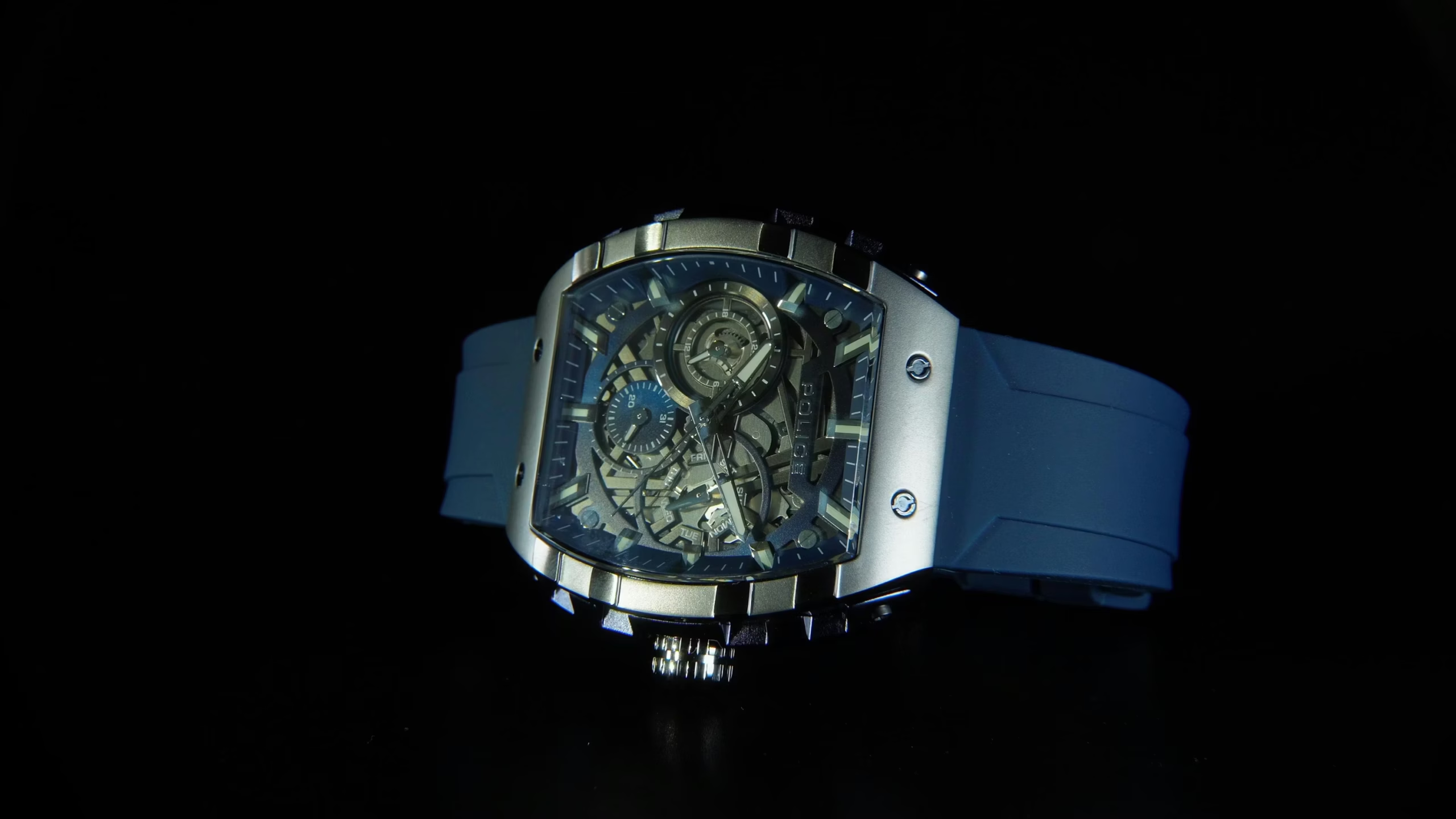
There is a watchmaker in the Vallée de Joux in Switzerland who makes approximately eight watches per year. Each one is a unique commission. His waiting list is closed. It has been closed for several years. The watches, when they do change hands — which happens rarely, always privately — sell for prices that are not discussed publicly. The maker’s name is known to a very small number of collectors globally.
He is not unusual, in this world. He is exemplary.
The Commission Hierarchy
The public understanding of high watchmaking is structured around retail: you visit a boutique, you select a reference, you join a waiting list if required. This is fine for watches priced at €10,000 to €200,000 and produced in meaningful quantities.
Above that level, the mechanism is entirely different. The major maisons — Patek Philippe, A. Lange & Söhne, F.P. Journe, Richard Mille — maintain special commissions departments that are not publicly communicated. Entry to these departments requires either a long relationship with the house, an introduction from an existing client at the right level, or acquisition of a meaningful collection of the brand’s existing work.
The commission process itself is not a transaction. It is a conversation. The client proposes a concept. The manufacture evaluates whether it is technically achievable and aesthetically consistent with the house’s identity. They may decline. Even clients with the financial means and relational access do not automatically receive a yes.
Why Watches at This Level Are Not Really About Timekeeping
A one-of-a-kind commission from a high watchmaking ateliers is, at the technical level, a piece of mechanical engineering of extraordinary complexity. The movements — hand-finished, often featuring complications that require years to develop — represent a convergence of mathematics, metallurgy, and craft that has no industrial parallel.
But the reason clients commission them is not primarily technical. It is the creation of an object that has no duplicate anywhere in existence — that embodies a specific relationship between a person and a maker, formalised in precious metal and sapphire crystal. This is the irreducibility argument for physical luxury: it is the opposite of the digital, where copies are infinite and ownership is illusory.
The Secondary Market You Cannot Access
Watches at this level — unique commissions from revered independent makers — rarely enter the public secondary market. When they do, they tend to surface at Sotheby’s or Christie’s Important Watches sales, where they achieve multiples of their original commission price. The Patek Philippe ref. 1518 in stainless steel, a unique-in-material-specification piece, sold for over $11 million in 2016 and reset the benchmark for what a wristwatch could be worth.
More commonly, these pieces are transmitted privately between collectors who already know each other — the same mechanism as the broader ultra-luxury market.
The Parallels with Private Aviation
What strikes me about this world — and about the world hype.luxury operates in — is the consistency of the underlying logic. Whether we are talking about a unique watch commission, a private island charter, or a Gulfstream G700 positioned to your specification, the product is fundamentally the same: something made specifically for you, available to no one else, negotiated through relationships that took years to build.
The currency is not money. Money is the entry ticket. The currency is reputation, relationship, and demonstrated taste.