

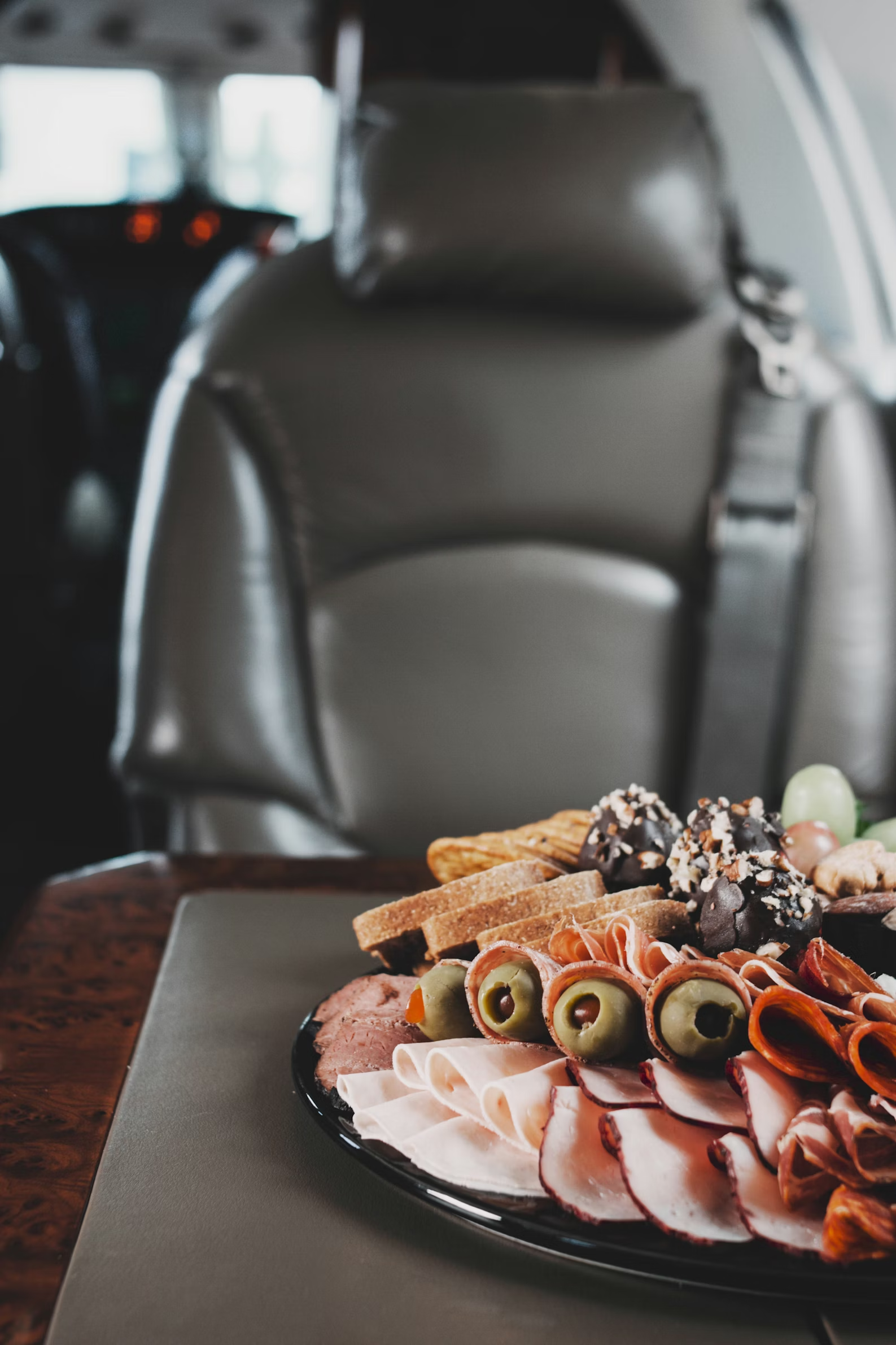
Ask any experienced private aviation advisor what they look at first when evaluating an unfamiliar operator, and a surprising number will mention catering. Not because food is the most important operational variable in private aviation — it is not — but because the way an operator manages catering is among the most reliable diagnostic indicators of how they manage everything else.
The logic is straightforward. Catering for private aviation is a logistically complex, highly personalised, time-sensitive operation. It requires coordination between the operator’s client management team, an external catering supplier, the crew responsible for handling and presenting the food, and the ground handling team at the departure facility. It requires accurate preference capture, reliable supplier relationships, and the operational discipline to ensure that a specific requirement — a dietary restriction, a preferred brand of sparkling water, a request for a specific cuisine at an unusual departure time — is fulfilled correctly and consistently, not just on the first flight but on every subsequent flight.
An operator who gets catering right has, almost by definition, built a functional client management system. They are capturing information correctly. They are communicating it accurately to multiple parties. They are following up to ensure execution. They are creating feedback loops that improve performance over time. These are the same capabilities that determine whether an aircraft departs on schedule, whether a crew is briefed correctly, whether a handling agent at a destination airport has been properly prepared. Catering is, in this sense, a microcosm of operational quality.
The opposite is equally diagnostic. An operator who repeatedly serves a passenger the meal that was correct six months ago but is no longer preferred — or who cannot reliably deliver a specific requirement across different departure cities — is an operator whose client management system is not functioning. The same system failure that produces the wrong salad dressing will produce a crew who was not informed that the principal has a late arrival and will need ground transport coordinated immediately on landing.
For principals who travel frequently on the same aircraft or with the same operator, the catering conversation is also a useful instrument for establishing the depth of the relationship. A genuinely attentive operator does not ask the same preference questions on every booking. They have a profile. They update it. They anticipate preferences based on the pattern of previous trips — understanding, for example, that a principal who travels to a specific city for a specific type of meeting tends to prefer a lighter meal on the outbound leg and a full service on the return. This level of intelligence is not data collection. It is client knowledge. There is a difference.
There is also a practical dimension to catering at altitude that is less discussed but operationally significant. Cabin pressure at cruising altitude affects taste perception — salt and sugar receptors are partially suppressed, and dryness from the pressurised environment alters the experience of food and drink meaningfully. Operators who understand this design menus accordingly, favouring preparations and ingredients that perform better in pressurised environments and hydration strategies that are actively rather than passively managed. This is not gastronomy for its own sake. It is crew intelligence applied to the condition of the passenger on arrival.
The best meal served on a private aircraft is the one you did not have to think about ordering, because the people responsible for your flight understood — without being told again — exactly what you needed.
That understanding is the product. The food is just the evidence of it.