

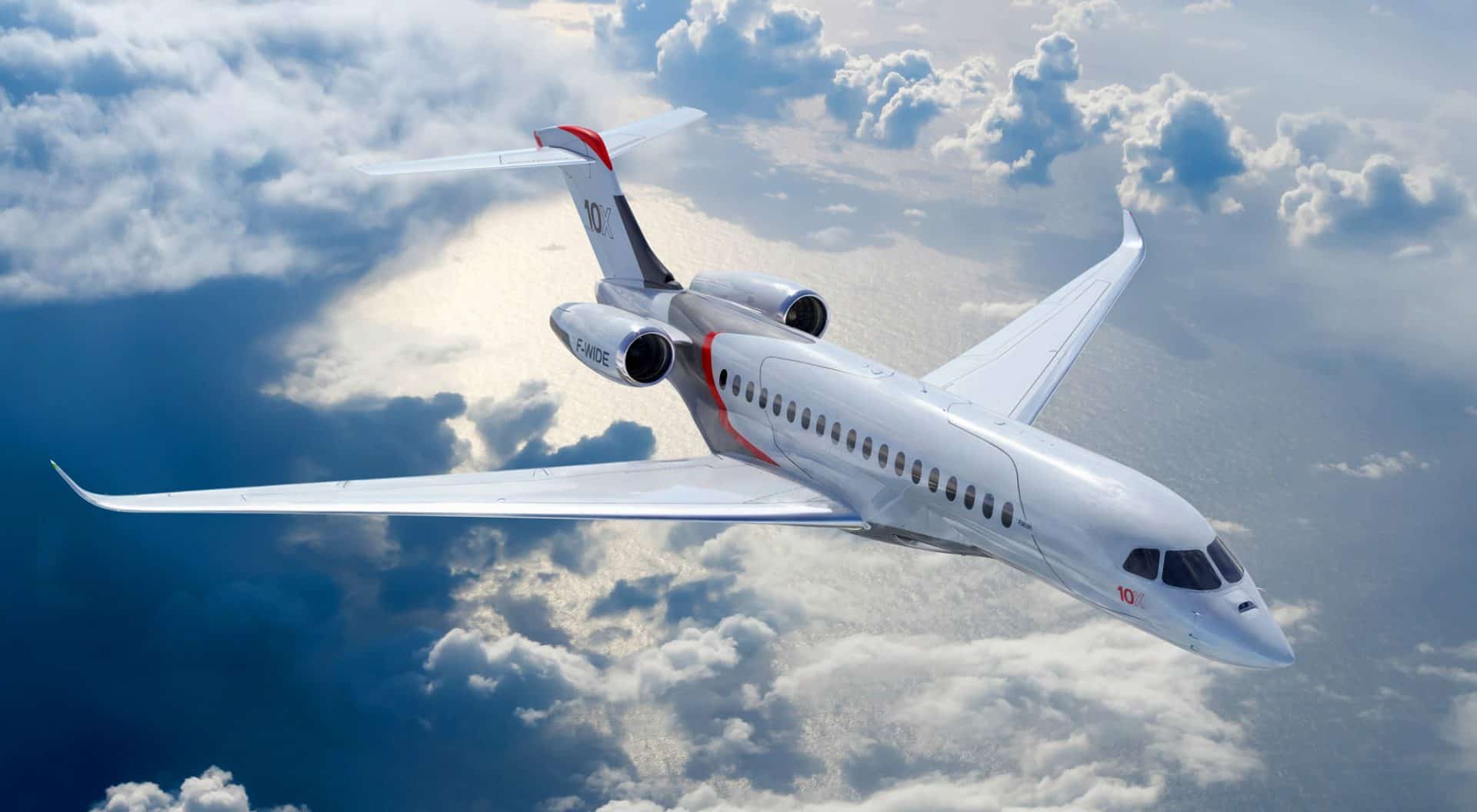
Dassault Aviation has built its reputation on a simple promise: military-grade engineering applied to civilian luxury. For buyers considering the brand in 2026, there are two aircraft worth knowing — one flying today, one arriving in 2027 — and the choice between them comes down almost entirely to timeline and mission profile.
The Dassault Falcon 6X entered service in November 2023 after EASA and FAA certification and has quickly become one of the most talked-about aircraft in its class. Its precursor, the Falcon 5X, was launched in 2013 but development was frozen when its Safran Silvercrest engine failed to meet performance objectives. The 6X was relaunched in December 2017 as a stretched version with PW812D turbofans. The persistence paid off. The Falcon 6X carries a stand-up cabin over two metres wide, a low cabin altitude, a quiet cabin, and a fresh air filtration system designed to help passengers arrive feeling genuinely refreshed. It features 30 large windows for natural light, along with the first skylight ever fitted to a business aircraft. Range sits at 5,500 nautical miles at a cruising speed of Mach 0.90, connecting major global cities including New York to Geneva, Paris to Singapore, or Dubai to Tokyo without compromise.
Pricing for the Falcon 6X is approximately $52.75 million, with an annual operating budget of about $3.10 million at 200 flight hours. Charter rates for the aircraft typically run between $10,000 and $13,000 per flight hour for buyers who want to test the aircraft before committing to ownership.
The Falcon 10X is Dassault’s answer to the ultra-long-range flagship category currently dominated by the Gulfstream G700 and Bombardier Global 7500. Launched in May 2021 at a price point of $75 million, the 10X is designed to compete directly with both rivals. Originally scheduled for 2025 deliveries, the programme has shifted and the aircraft is now expected to begin deliveries in 2027. The fuselage runs 33.4 metres long with a cabin width of 33.6 metres at its widest point — figures that, if realised as designed, would give the 10X one of the most generous cabin cross-sections in business aviation.
For buyers who need an aircraft now, the 6X is flying, certified, and delivering. Its 5,500 nautical mile range covers the vast majority of global business routes, and its cabin comfort credentials — tallest and widest in its class according to Dassault, reinforced by design awards including the Red Dot Award — make it a genuinely compelling aircraft on its own merits, not simply a placeholder while waiting for something larger.
For buyers planning a 2027 or later acquisition who want true G700 and Global 7500 competitive range and cabin scale, the Falcon 10X is worth tracking closely. Dassault’s engineering pedigree across the Falcon family — particularly the brand’s reputation for handling characteristics derived from its military aviation heritage — gives serious buyers reason to wait if the timeline allows.
The decision ultimately rests on one question: do you need the aircraft in your hangar this year, or can your acquisition timeline absorb a 2027 delivery for genuinely flagship-level range and cabin volume? Both are legitimate answers, and Dassault has built a credible aircraft for each one.
Image: Dassault Aviation