

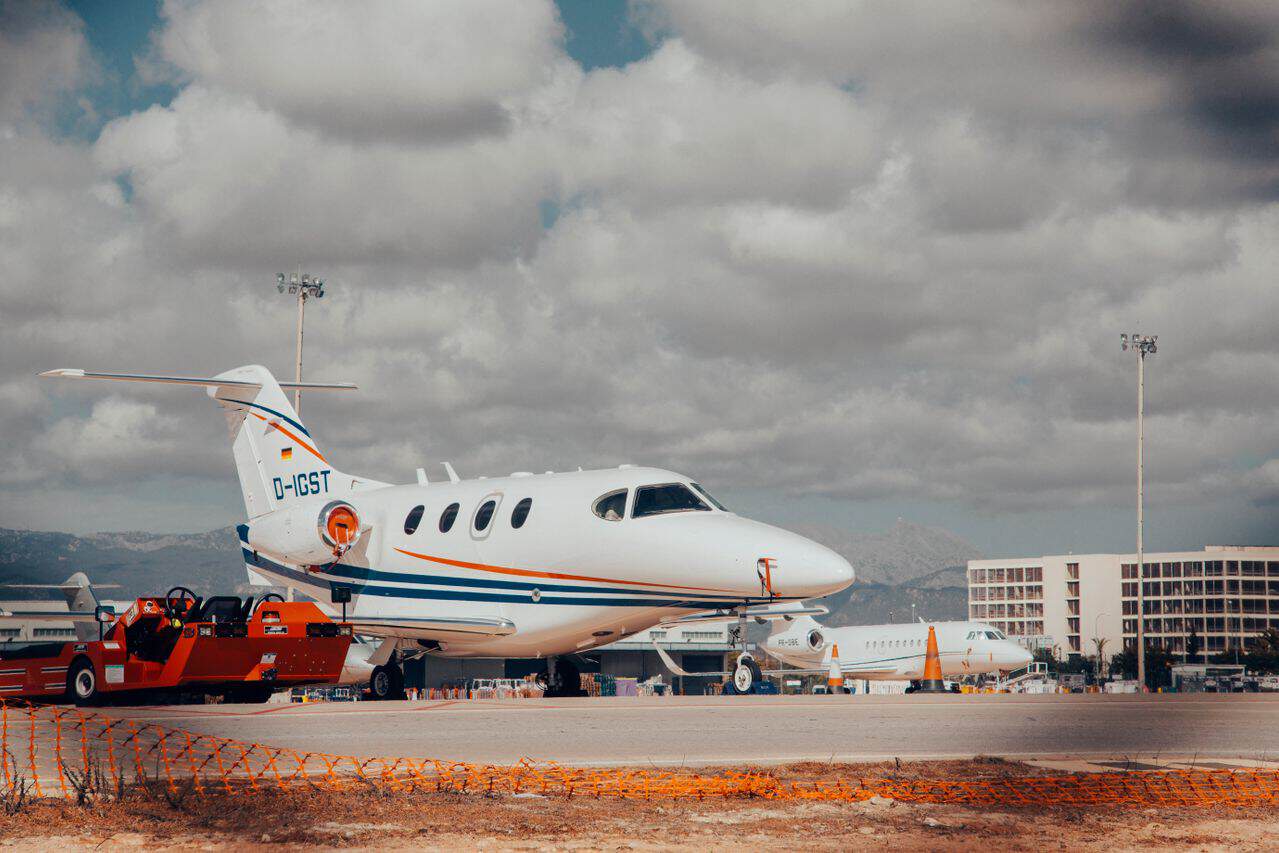
The private jet’s most underappreciated advantage over commercial aviation is not the cabin. It is the airport. While commercial aviation funnels travelers through a small number of hub airports — massive, congested, and distant from most final destinations — private aviation’s network of approximately 5,000 airports globally places arriving travelers meaningfully closer to where they actually want to be.
Understanding which airports serve which destinations — and which aircraft can access them — is the operational knowledge that distinguishes sophisticated private aviation clients from those who simply book the most obvious route.
Courchevel Altiport (France): The Most Dramatic Landing in Alpine Aviation
At 2,008 meters altitude in the French Alps, Courchevel Altiport has a runway of 537 meters with a 19% gradient — the most severe of any public-use altiport in the world. The approach requires a dedicated mountain qualification; the landing produces a sight line over the piste that is unlike anything in civilian aviation.
Accessible to: turboprops (Pilatus PC-12, King Air) and selected light jets with short-field performance. Not accessible to: midsize jets and above. The client arriving in Courchevel by PC-12 while their commercial-traveling counterpart transfers through Lyon and takes a three-hour coach saves approximately five hours of travel time.
Samedan Airport (Switzerland): The St. Moritz Gateway
At 1,822 meters in the Engadin Valley, Samedan is the highest airport in Switzerland and the primary access point for St. Moritz’s winter and summer seasons. The combination of altitude, alpine valley approaches, and seasonal weather makes it a genuinely demanding airport — and one that the finest operators handle with appropriate qualification requirements.
Accessible to: midsize jets and smaller, with appropriate crew qualifications. The BBJ and ultra-long-range category must position to Zurich or Milan.
Cannes Mandelieu (France): The Riviera’s Private Terminal
The Cannes Mandelieu airport’s private terminal — a 20-minute drive from the Croisette — is one of the most consistently busy in European private aviation, particularly during the Film Festival and Grand Prix weekends. Its intimacy (one main terminal building, limited ramp space) creates the particular atmosphere of an airport where everyone present has chosen to be there rather than been directed there.
Teterboro Airport (New Jersey): New York’s Private Aviation Capital
For Manhattan-bound travelers arriving on the US East Coast, Teterboro (TEB) is the private aviation gateway — 12 miles from Midtown Manhattan, with multiple FBO options and the infrastructure to handle the extraordinary volume of private aviation traffic that serves the New York market. A car from Teterboro to Midtown in non-peak traffic: approximately 20 minutes. From JFK, the equivalent commercial journey: 60-90 minutes.
Le Bourget (Paris): The World’s Largest Private Aviation Facility
Le Bourget — 12 kilometers north of central Paris — is the world’s largest private aviation airport by movement volume, handling approximately 53,000 private aircraft movements annually. Its scale provides the infrastructure for ultra-long-range aircraft including BBJs, its proximity to Paris makes it genuinely competitive with CDG for time-conscious travelers, and its ground handling options include several of the finest FBOs in European aviation.
At Hype Luxury, our routing intelligence includes airport capability assessment — ensuring every aircraft booking uses the closest appropriate airport to the final destination, not just the most obvious one.