

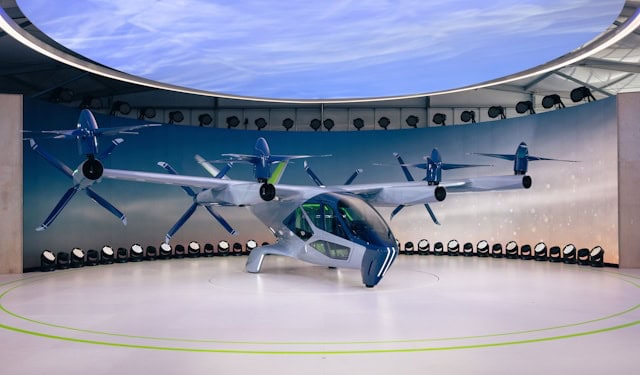
The helicopter was the original vertical mobility solution for the ultra-wealthy. Loud, expensive to operate, limited in range, and requiring a pilot with a highly specialised licence — it was access through friction. The eVTOL changes that equation entirely.
Electric vertical take-off and landing aircraft — eVTOLs — are the technology that the luxury mobility world has been watching move from prototype to operational reality. At CES 2026, the category commanded some of the show’s most significant floor space and agenda time, with exhibitors demonstrating autonomous flight systems, hyper-connected management platforms, and cabin experiences that belong in a conversation about private aviation rather than commuter transit.
The proposition is genuinely transformative. An eVTOL eliminates the airport entirely. It lifts from a rooftop, a helipad, a private estate, or a purpose-built vertiport and delivers a passenger to their destination with the efficiency of a helicopter, the running costs of a fraction of a conventional aircraft, and — increasingly — the capability to operate autonomously.
For UHNW individuals, the implications play out across multiple dimensions of daily life. The journey from a private residence in Monaco to Nice Côte d’Azur airport, which could take forty-five minutes by road during peak season, becomes a seven-minute aerial transit. The connection between a private island in the Maldives and the nearest international hub — historically a lengthy boat transfer — becomes a precise, on-demand flight. The last-mile problem that dogs even the most sophisticated private aviation itinerary simply disappears.
For family offices, eVTOL introduces a new category of mobility asset to consider. Several manufacturers are already offering ownership or fractional interest in specific aircraft, analogous to the jet card and fractional ownership models that transformed private aviation access in the early 2000s. The principals who establish relationships with leading eVTOL operators now — before waitlists form and allocations tighten — will have access that later entrants simply cannot acquire at any price.
The urban air mobility infrastructure is developing rapidly. Multiple cities have committed to vertiport networks integrated with premium residential and commercial districts. The vision — moving through a city at altitude, bypassing gridlock entirely — is no longer a concept. It is scheduled, and in several markets, already operational.
There is also a design story here that deserves attention. The interiors of premium eVTOL cabins are being crafted by the same studios that design private jet interiors. Materials, acoustics, lighting, and connectivity are being specified to the standard of a Gulfstream or Dassault Falcon — in a vehicle that needs no runway and costs a fraction of the operational overhead.
The eVTOL category will, within the next decade, be as embedded in the UHNW lifestyle as private aviation. The difference between those who shaped their relationship with this technology in 2026 and those who discovered it in 2030 will be measured in access, positioning, and the specific allocation relationships that no money can simply buy after the fact.
At Hype Luxury, we are already in dialogue with the leading eVTOL manufacturers and operators on behalf of our clients. The waitlists for the most desirable allocations are forming now.