

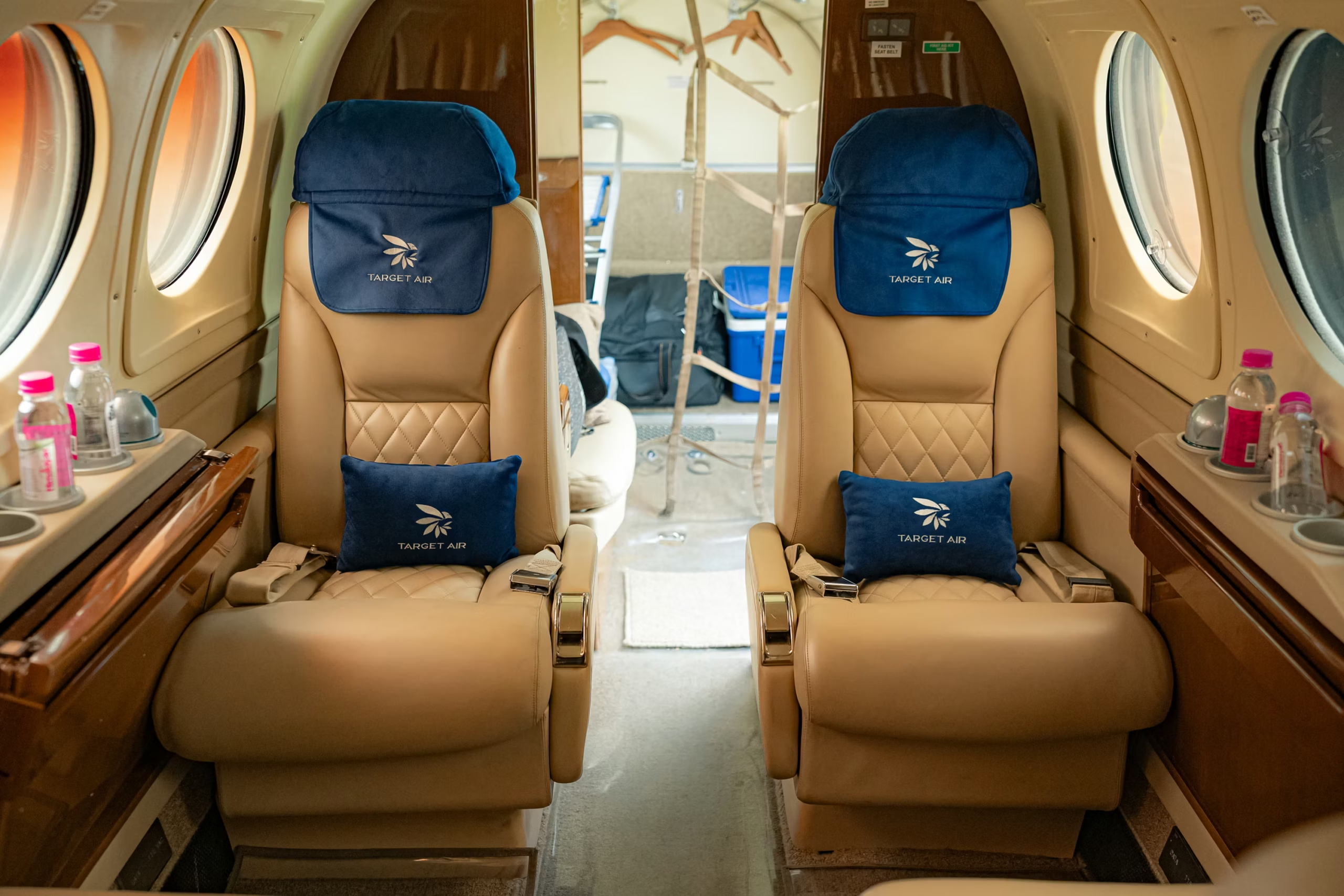
The popular image of private jet travel is champagne at boarding, a model-adjacent companion in the seat across, and an arrival at Nice Côte d’Azur timed perfectly for a summer afternoon. This image is not entirely false — the occasion exists. But it represents perhaps 10% of how serious operators actually use private aviation.
The other 90% is unglamorous. Early morning departures. Short-hop routes between cities that commercial options serve badly. Back-to-back meetings in two cities in a single day, made possible only because the aircraft waits. Late-night repositioning. Families travelling in configurations that commercial aircraft cannot accommodate. Medical situations that require immediate, controlled transport.
Private aviation, at its core, is a time management tool.
The Productivity Calculus
A senior Indian industrialist who divides time between Delhi, Mumbai, and Bengaluru loses, on a commercial schedule, approximately 8–12 hours per week to airport processes, schedule inflexibility, and transit time on indirect routes. Over a 48-week working year, that is 400–600 hours.
At any serious valuation of that individual’s time, the cost-benefit calculation for private aviation is not close. It is not a luxury decision. It is an operational one.
Security as the Underreported Driver
Political and reputational exposure at the UHNW level creates genuine security considerations that commercial travel cannot adequately address. The known schedule, the public terminal, the inability to control who is on the same aircraft — these are manageable risks for most people. For founders of significant enterprises, prominent political families, or individuals in disputed sectors, they are not.
Private aviation provides schedule opacity, terminal privacy, and control over the passenger manifest. For a meaningful subset of serious users, these are not conveniences. They are requirements.
The Fleet Strategy: Own, Charter, or Fractional?
The ownership question is more nuanced than popular understanding suggests. Outright ownership is often not the optimal solution even for very frequent flyers, because it generates a fixed overhead regardless of usage intensity. Fractional programmes — NetJets, Flexjet — offer a middle ground with guaranteed availability and shared operating costs. Charter provides maximum flexibility with no fixed commitment.
Most sophisticated users of private aviation move between these models as their needs evolve. The intelligent approach is not to find the right permanent solution, but to retain the flexibility to optimise.
What the Indian Market Gets Right
India’s private aviation market has developed a sophistication that surprises international observers. The client base is primarily business-driven, the usage patterns are intensely practical, and the value placed on reliability and ground handling quality has pushed domestic operators to standards that rival global benchmarks.
The route network that hype.luxury services — India, Dubai, Monaco, London — reflects exactly this pattern. These are not leisure itineraries. They are the geographic footprint of serious operators whose business and personal lives span multiple jurisdictions. The aircraft is the thread that connects them.
Charter as the Intelligent Entry Point
For clients exploring private aviation for the first time, charter is both the lowest-commitment and the highest-information option. You learn, across several experiences, what aircraft type suits your typical mission, what crew service standards you require, what ground handling matters to you. By the time you make a commitment to fractional or ownership, the decision is informed rather than aspirational.
At hype.luxury, we structure our client relationships around exactly this learning curve. The goal is not to close a transaction. It is to match the right solution to the right client at the right stage of their relationship with private aviation.