

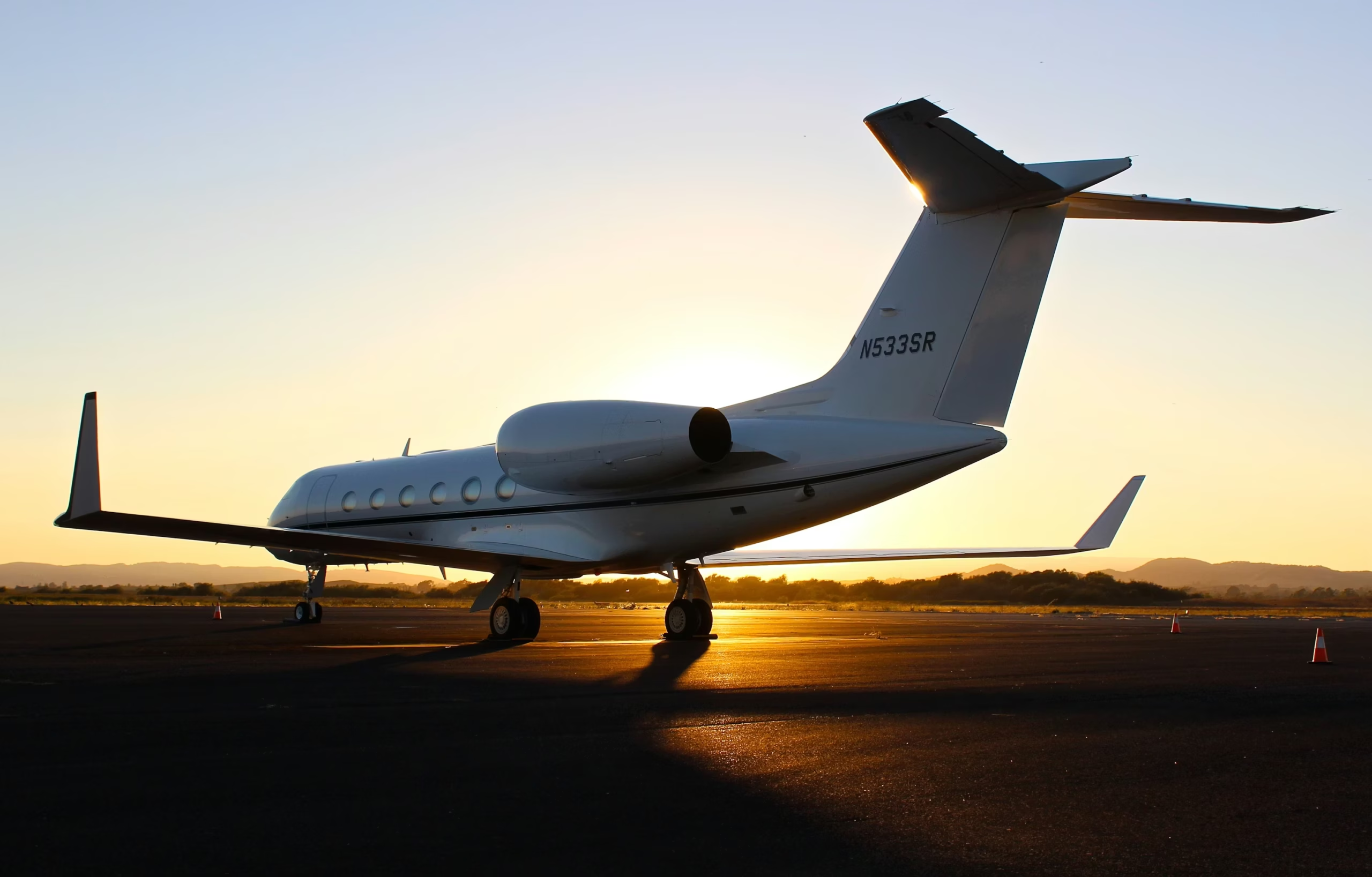
If you mapped the movement of global wealth by private aviation, two cities would appear at opposite ends of the most active ultra-long-range corridor in the world.
Singapore. Dubai.
The sector is approximately 5,800 kilometres. Flight time in a large-cabin ultra-long-range jet: 7 to 7.5 hours. This is a non-stop route only for the top category of private aircraft, and the clients who fly it regularly know precisely what the journey requires.
Why This Corridor Matters
Singapore and Dubai have become the two principal hubs for globally mobile wealth in the Eastern and Western hemispheres respectively.
Singapore’s appeal: political stability, the world’s most respected financial regulatory environment, English as the language of business, strategic position at the intersection of Southeast Asian and Chinese economic flows, and a tax architecture that is efficient without being aggressive.
Dubai’s appeal: zero personal income tax, the UAE Golden Visa framework, the DIFC as the Gulf’s premier financial hub, and a government that has spent two decades building the infrastructure that mobile wealth requires.
The families who operate across both — and there is a significant and growing number of Indian, Chinese, European, and Middle Eastern families doing exactly this — are on this route consistently. Some of them are on it monthly.
The Aircraft Requirement
This is a route where aircraft selection is not a preference question. It is a technical one.
The Singapore-Dubai sector at approximately 5,800 nautical miles sits at the edge of midrange capability and requires a confirmed large-cabin ultra-long-range aircraft to guarantee non-stop performance under all wind conditions.
The Gulfstream G650 and G700, the Bombardier Global 7500, and the Dassault Falcon 8X are the aircraft categories that can be confirmed for this route with confidence. Anything smaller or shorter-ranged introduces technical stop risk that, on a route where the alternative to non-stop is a significant and disruptive delay, is not acceptable.
What the Journey Looks Like
Seven hours in a properly equipped large-cabin jet is, for clients who use the cabin correctly, productive in ways that commercial business class is not.
Calls that cannot be taken in a shared cabin. Meals prepared to specification. Work, rest, and the transition between destinations that begins not at the arrival terminal but in the air.
The cost: $95,000 to $160,000 one-way for a verified non-stop operator in the appropriate aircraft category.
The alternative — commercial business class with a connection — is available. The question is not whether the alternative is possible. It is what the seven hours is worth.
Scheduling the Route
The Singapore-Dubai sector is time-zone complex in the eastbound direction. Departing Singapore at 9pm arrives in Dubai at approximately 2am local. Departing in the morning arrives mid-afternoon.
Most clients flying westbound prefer morning departures — arriving in Dubai in the afternoon, having worked or rested on the aircraft, ready to engage with the city they have arrived in.
At Hype Luxury, our network for this sector is built around verified non-stop operators. Because on a route this consequential, the only variable that should matter is what you achieve in the cabin.
The world’s two most important wealth hubs. Seven hours between them. One conversation that needs to happen in the air.