

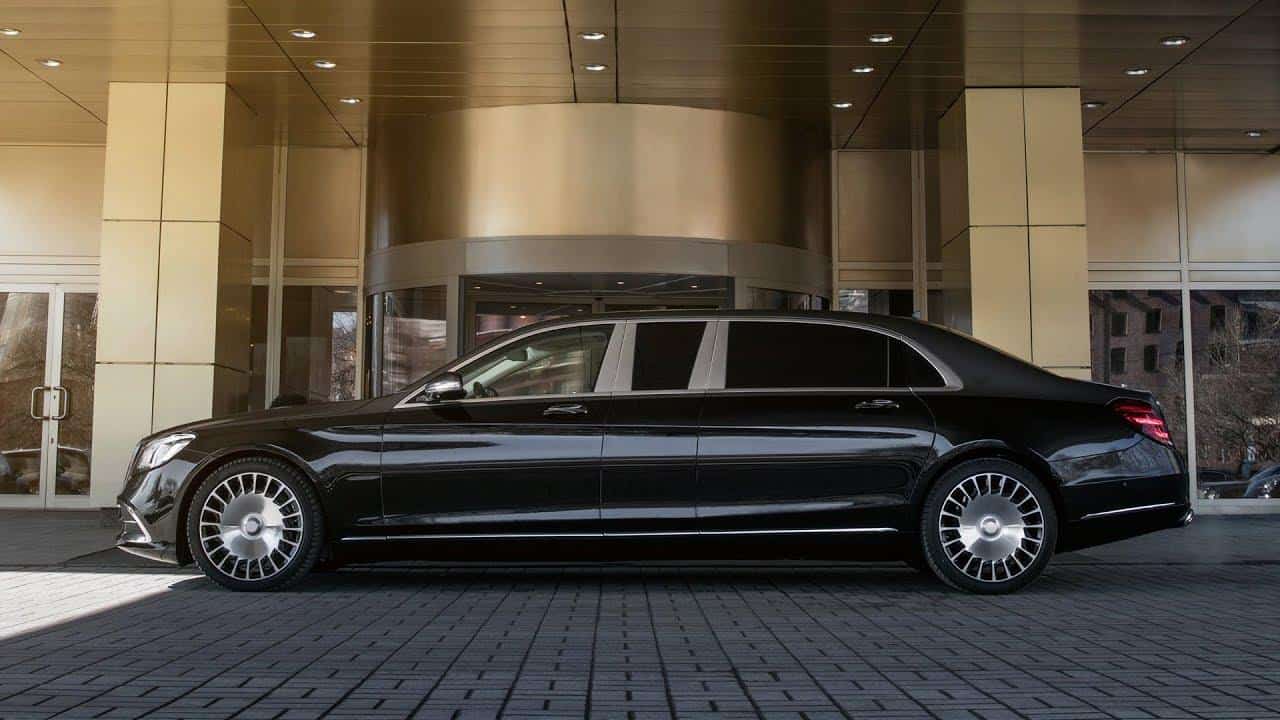
It does not draw attention. It does not carry identifying markings. It does not look like anything in particular.
It is typically a vehicle that would not merit a second glance in any city in the world — a dark Mercedes GLS, a silver Range Rover, an anonymous black Lexus LX. From the outside, it appears entirely unremarkable. From the inside, it is one of the most sophisticated protective environments ever built for private use.
This is the quiet revolution happening at the upper end of luxury ground transportation. And for family offices and principals managing extreme wealth, it has become one of the most consequential decisions in personal security planning.
The global armoured vehicle market has changed
The civilian armoured vehicle market reached approximately $51.6 billion in 2025, driven not merely by government and diplomatic procurement but by a profound shift in private demand. Ultra-high-net-worth individuals, founders of multi-billion dollar companies, and internationally mobile family principals are increasingly approaching personal ground transportation as a security architecture decision — not a lifestyle one.
The question is no longer whether to armour a vehicle. For a growing cohort of globally mobile principals, the question is how to armour it without anyone knowing.
This is a meaningful distinction. The era of bulletproof SUVs that telegraphed their own protection through conspicuous bulk, diplomatic plates, or obvious modifications is giving way to something far more sophisticated. The most advanced armoured conversions today — from vehicles like the Rolls-Royce Cullinan, the Mercedes-Maybach S680, and the Range Rover Autobiography — preserve the precise visual language of the unmodified vehicle. Interior dimensions, ride quality, and acoustic profiles remain effectively unchanged. The only thing that differs is what happens when someone attempts to cause harm to the occupants.
Why discretion has become the primary protection
The logic is counterintuitive at first glance. Surely a heavily armoured vehicle — one that announces its own protection — would serve as a deterrent? In practice, the opposite is increasingly true.
A vehicle that visibly signals the importance of its occupant is, simultaneously, a vehicle that signals the importance of its occupant. It identifies. It draws attention. It tells anyone paying attention that whoever is inside is sufficiently consequential to require military-grade protection.
For UHNW principals operating across complex environments — whether in Lagos, São Paulo, Mumbai, or indeed London and Monaco — this visible declaration of vulnerability-through-importance has become a liability rather than a deterrent. The most sophisticated threat actors target predictability and visibility, not protection levels alone. A vehicle that blends into the urban environment removes the first and most critical variable.
This philosophy extends beyond the vehicle itself. The most rigorous security thinking today integrates ground transportation into a broader environmental design — varying routes, times, and vehicle configurations; maintaining multiple vehicle options within a single fleet so no single pattern becomes identifiable; coordinating ground transfers with aviation departures and arrivals so that exposure at vulnerable transition points is minimised.
What family offices are beginning to understand
Family offices are increasingly engaging with ground transportation at the governance level — not merely as a logistics matter handled by a personal assistant, but as part of a broader principal protection framework that encompasses travel, communications, digital security, and residential access control.
This institutional shift has significant implications for how ground mobility is selected, maintained, and deployed. The question a sophisticated family office asks when evaluating ground transportation in a new geography is no longer simply “which car service do you recommend?” It has become: who trains the drivers, what protocols govern route selection, how are vehicle maintenance and modification records managed, and how does ground transport integrate with the principal’s aviation movements?
These are not questions that commodity car hire services are equipped to answer. They are questions that require a mobility partner with genuine operational depth — one who understands not merely transportation but the full architecture of how internationally mobile wealth moves.
The India corridor: a specific and growing consideration
India’s emergence as one of the world’s most dynamic wealth creation environments has brought its own specific ground transportation considerations. The country’s UHNW population is growing rapidly, and with it, demand for sophisticated ground mobility that meets international standards in a domestic environment that remains logistically complex.
Traffic density in Mumbai, Delhi, and Bengaluru creates specific operational challenges. Armoured vehicle modifications must account for these environments — where low-speed maneuvrability, driver training for dense urban conditions, and rapid communication with security teams are as important as ballistic specifications. The vehicle appropriate for a principal moving between Mayfair and the City is not automatically appropriate for a principal moving between Bandra and BKC during peak hours.
This calibration — matching vehicle capability and driver protocol to specific geographic and operational contexts — is where the difference between a competent ground transport provider and a truly sophisticated one becomes apparent.
Mobility as architecture
The most useful frame for understanding ultra-luxury ground transportation at the highest level is not transportation at all. It is architecture.
Architecture creates environments. Architecture considers sight lines and exposure. Architecture thinks about what can be seen from the outside and what cannot. Architecture integrates form and function invisibly, so that the person inside simply experiences a coherent, calm environment that functions without calling attention to itself.
The finest ground transport at the UHNW level does exactly this. It creates a controlled environment within a public space. It extends the principal’s operational autonomy to one of the most exposure-intensive parts of any travel day. And it does so without declaring itself.
At Hype Luxury, ground mobility is understood as the closing element in an integrated movement architecture — the moment when aviation precision and superyacht-level discretion must translate seamlessly to the urban environment. It is the last mile and the first impression. And in certain environments, it is the moment that matters most.