

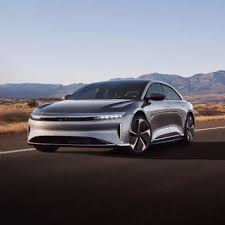
There is a moment in every industry when the upstart stops being a curiosity and becomes the standard. For luxury automotive, that moment arrived on a stage in April 2026, when Lucid Gravity was named the World Luxury Car of the Year — and the old guard had to stand and watch.
For decades, the hierarchy of automotive prestige was as fixed as the crests on the bonnets. Rolls-Royce for the truly untouchable. Bentley for the cultivated. Mercedes S-Class for the boardroom. These were not merely cars — they were instruments of social communication, physical signals of accumulated power. Their cabins smelled of leather tanned in specific regions of Europe. Their weight alone was reassuring.
Then came Lucid.
Founded on the premise that you should never have to compromise — on range, on performance, on refinement — Lucid built something that didn’t ask you to trade anything. The Gravity SUV arrived with over 440 miles of real-world range, a 0-to-60 time that embarrasses hypercars, and a cabin that automotive journalists struggled to describe without reaching for words like “otherworldly.” Its over-the-air software updates mean the car you own in 2027 is measurably better than the one you collected in 2026.
For UHNW clients and the family offices that support their lifestyle architecture, the Lucid Gravity win raises a question that is both commercial and philosophical: what does prestige mean when the most capable vehicle on the road no longer comes from a century-old European marque?
The answer, increasingly, is that prestige is being redefined by capability, not heritage. Affluent buyers under 55 — the generation that built or inherited significant tech and private equity wealth — are not nostalgic for the smell of hand-stitched Nappa leather. They are fluent in metrics. They want the car that wins on every dimension simultaneously. The Gravity is that car.
This shift matters profoundly for wealth advisors and family office executives who curate lifestyle assets. The vehicle in the garage is not a footnote to a client’s portfolio — it is often one of the most visible expressions of their values. A client who holds a stake in three clean energy funds and then arrives in a diesel-powered V8 is sending a message they may not have approved.
The most perceptive observers of the luxury automotive market note that the Lucid Gravity win is not an isolated data point. It is the leading edge of a structural reordering. The software-defined vehicle — one whose capabilities evolve post-purchase, whose performance is continuously optimised, and whose intelligence is built into every system — is not a feature of the future. It is the present, wearing a very expensive badge.
For UHNW principals who view their vehicles as extensions of their professional identity, the Gravity signals something important: the most credible statement of discernment in 2026 is not the most expensive car. It is the most intelligent one. And intelligence, in the automotive context, is now measured in software architecture as much as mechanical engineering.
At Hype Luxury, we track not just the vehicle launches but the meaning behind them. The Gravity win is not an automotive story. It is a cultural inflection point — and for clients who insist on being ahead of every curve, understanding why it won is where the real intelligence begins.