
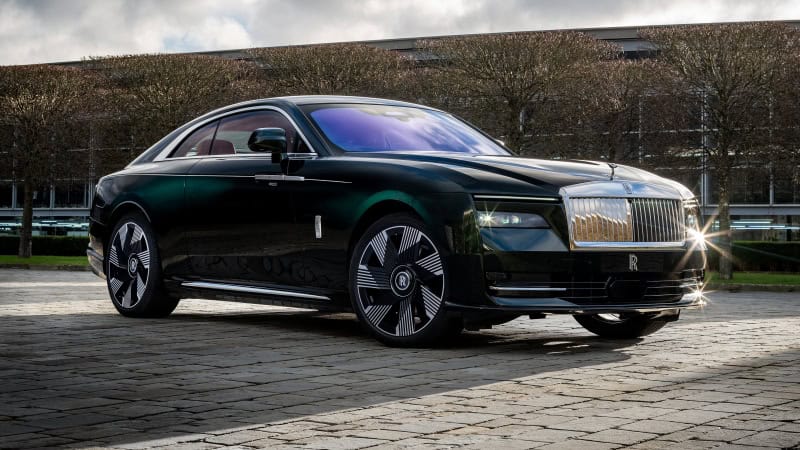
When Rolls-Royce announced that its first fully electric production model would be a two-door coupé carrying the name Spectre, the industry took it as a statement of intent rather than a product. Three model years in, the verdict is clearer: the Spectre did not simply enter the luxury electric market. It rewrote what that market could be.
The context matters. By the early 2020s, electric luxury had reached a strange impasse. The technology was extraordinary, but the cars built around it largely borrowed their visual and emotional language from technology rather than from luxury — speed metrics, screen acreage, the rhetoric of disruption. The world’s most exclusive automotive house concluded, quietly, that this was the wrong language. Electrification, they argued, should serve luxury, not redefine it. The Spectre was the answer.
Drive one, and the philosophy reveals itself immediately. The car is enormous, sculpted in the long-bonneted, short-decked proportions of a true grand tourer. The doors close like vault gates. The cabin — starlit headliner, Canadel panelling, deeply uncrowded — is unmistakably a Rolls-Royce. Then you press the throttle, and the Spectre delivers the one thing combustion never could: silence so complete that the design becomes audible. The clock ticks. The leather creaks faintly. The world outside, glimpsed through the bonnet’s long horizon, simply slides past.
That silence has done more for the perception of electric luxury than any specification sheet. Rolls-Royce did not chase Nürburgring times or zero-to-sixty bragging rights. They built the most refined large coupé in production, period — and the powertrain happened to be electric. The car argues, in every mile, that the highest expression of luxury is the absence of intrusion, and that the electric drivetrain finally allows that expression to be complete.
The market response has reshaped the conversation. Competing houses, having watched the Spectre’s order books, have abandoned the assumption that ultra-luxury electric must look or feel like advanced technology. The forthcoming wave of luxury EVs — from Bentley’s electric flagship to the next generations of Maybach electric models — will be measured against the Spectre’s benchmark, which is essentially: does the car feel like luxury, not like a demonstration?
For the rental and charter market, the Spectre has had its own quiet effect. Demand for the model in the world’s elite luxury rental fleets has been immediate and persistent. Clients who have never driven electric have used Spectre rentals as their introduction — a weekend with the coupé, often in Dubai, Monaco or the Côte d’Azur, that has converted more skeptics to electric luxury than any showroom test drive could.
There are practical realities. The Spectre’s mass — more than two and a half tonnes — and its range, capable rather than class-leading, mean it is engineered for the boulevard rather than the cross-continental dash. This is not a flaw. It is a refusal to compete on metrics that miss the point. The Spectre is a car for arriving, and for the long, quiet, considered drive — exactly the use case for which Rolls-Royce has built every car in its history.
The deeper legacy is philosophical. The Spectre proved that the world’s most prestigious automotive house could electrify on its own terms, without apology and without imitation. It rescued electric luxury from the temptation of becoming merely fast technology, and returned it to what luxury has always been about: the unhurried, the silent, the unmistakable.
The future of luxury motoring will be electric. The Spectre simply ensured it would also, still, be luxury.