
Monaco receives enormous attention as the definitive address of European wealth. 39,000 people. The highest concentration of millionaires per capita anywhere on earth. No income tax. Formula 1 through the streets annually. It is, by any measure, a remarkable place to be wealthy.
It is also, increasingly, not where the most serious money lives.
The Problem with Famous Addresses
The fundamental tension at the apex of residential luxury is between visibility and security. The most famous addresses — Monaco, Mayfair, the Upper East Side, the Peak in Hong Kong — attract wealth partly through the signal they send. To live there is to announce a certain level of achievement.
But announcement is, for the truly wealthy, a liability. It generates security concerns. It attracts unwanted approaches. In an era of geopolitical volatility, it makes individuals and their families legible to a range of actors whose attention is not desirable.
The response, for those who have moved past the signalling phase, is strategic invisibility.
Where the Serious Money Has Actually Gone
The Cotswolds in England has quietly become one of Europe’s most concentrated repositories of serious wealth, precisely because it looks like the English countryside. Estates here — often historic, often requiring significant restoration investment — provide security, privacy, and genuine agricultural land as an asset class.
New Zealand’s South Island has attracted a meaningful number of Silicon Valley and tech-adjacent billionaires over the past fifteen years. The appeal is geographic isolation, political stability, clean water, and the ability to build infrastructure — airstrips, communications, medical facilities — on private land without the regulatory complexity of more scrutinised jurisdictions.
In India, the equivalent is beginning to emerge in Alibaug, certain parts of Goa, and the larger private estates in Rajasthan — locations where a wealthy family can own meaningful land and control their environment, rather than occupying a floor of a tower in a city where thousands of people live within metres of them.
The Private Island as Residential Strategy
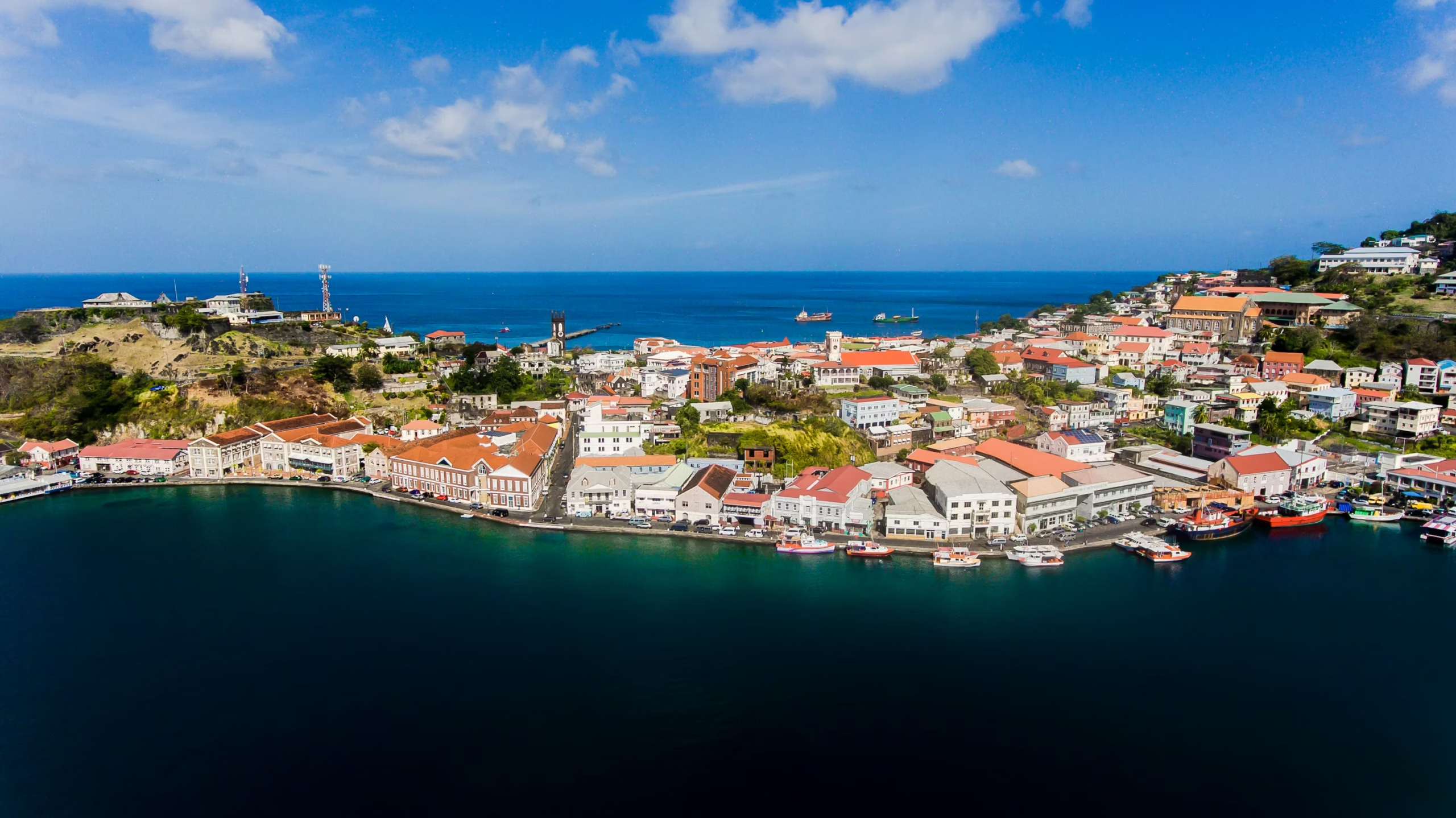
The private island is often treated as the ultimate luxury flex. It is, in practice, a serious infrastructure project. Power, water, communications, medical access, staff accommodation, and supply chain logistics are all the owner’s responsibility. The islands that work — Musha Cay, Necker Island, Calivigny in Grenada — have succeeded because their owners treated them as operational challenges, not aesthetic ones.
For those who want the experience without the management commitment, private island charter is a significant and growing market. Spending three weeks on an island that someone else has built and maintains is not a lesser version of ownership — for many clients, it is the superior choice.
The Aircraft as the True Primary Residence
There is a cohort of individuals — genuinely global operators — for whom no fixed address is primary. Their life is structured around their aircraft. The Gulfstream or Global Express is their conference room, their bedroom, and their geographic freedom. Home is wherever the next engagement is.
This is not a fantasy. It is a specific lifestyle architecture, and it is more common than popular imagination suggests. At hype.luxury, we have clients who are more familiar with the configuration of their charter aircraft than the layout of any house they own.
The address, in other words, is the sky.