

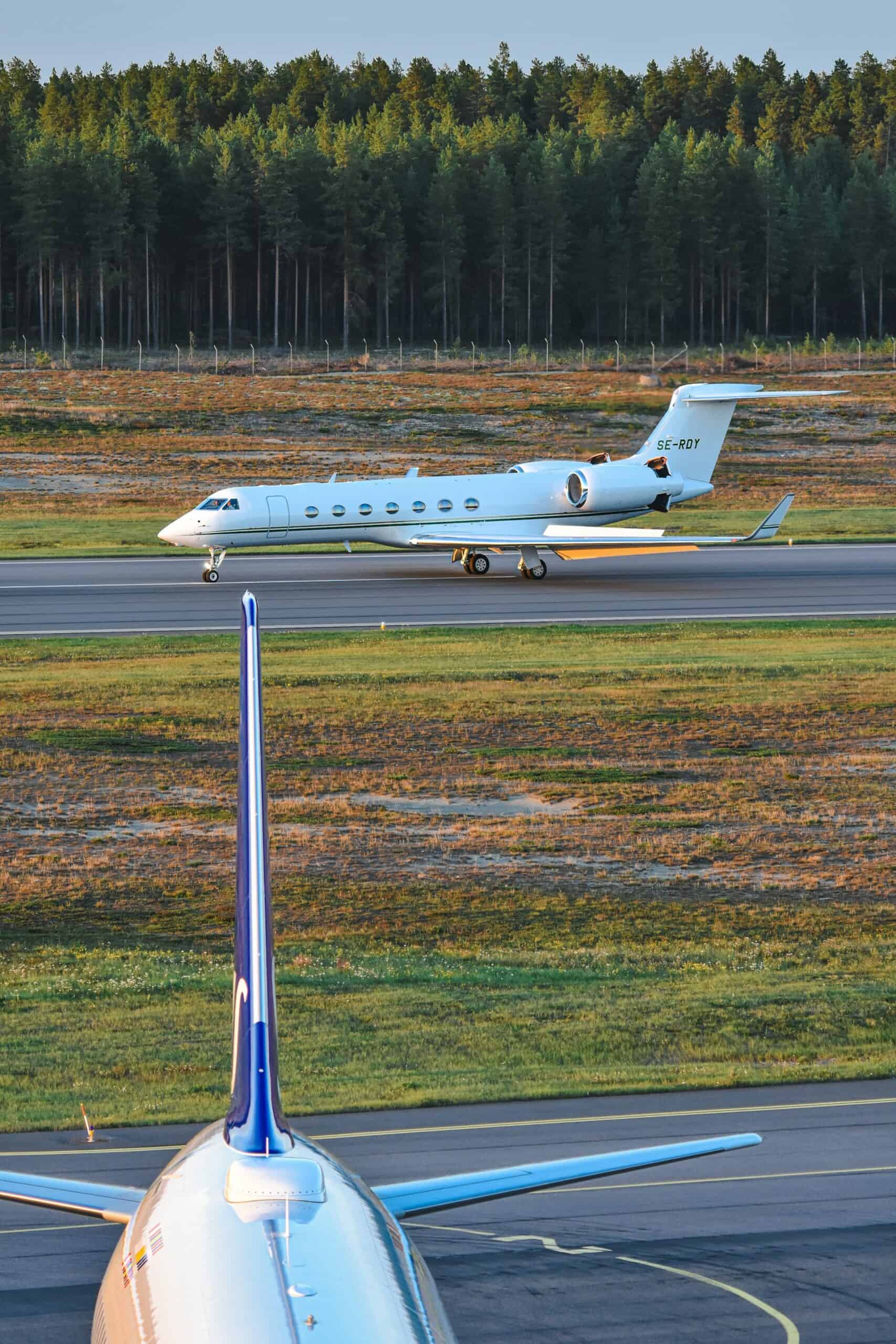
The private aviation industry has achieved a technological inflection point. Ultra-long-range aircraft capable of flying over 7,500 nautical miles without refueling—enabling non-stop travel from New York to Hong Kong, London to Sydney—have shifted from aspirational to operational standard for ultra-high-net-worth principals.
Gulfstream’s G700 ($80 million), Dassault’s Falcon 10X (competing at the ultra-premium tier), and Bombardier’s Global 7500 represent a fundamental reshuffling of principal mobility calculus. Previously, transatlantic and transpacific travel required refueling stops, crew positioning, and overnight staging—operational friction that compressed productivity windows.
The G700 eliminates this friction entirely. With 14-hour range capability, it operates nonstop between any two major financial centers on Earth. More critically, the cabin configuration accommodates 13 passengers in full residential-grade comfort: a grand suite with shower, separate bedrooms, boardroom, and galley. This is not airline-style seating. This is a flying apartment equipped for simultaneous working operations and crew rest.
For principals managing family offices across multiple continents, the operational value is quantifiable. A principal can depart New York at 2 PM, conduct uninterrupted business operations during an 8-hour flight, arrive in London at 2 AM local time, rest in the grand suite for 4 hours, and be operational for morning meetings—all without commercial aviation friction. The aircraft delivers 24-hour productivity compression that commercial aviation cannot match.
Aircraft manufacturers have weaponized range competition. The G700’s 5,700-nautical-mile range is explicitly marketed against previous-generation platforms. Dassault’s Falcon 10X, still in development, is being positioned as the response—capable of competing directly at the highest tier with cabin customization exceeding even Gulfstream’s flagship offering.
The market consequence is rapid platform consolidation. Platforms with 5,000+ nautical mile range are becoming non-negotiable for new UHNW aircraft acquisitions. Mid-range platforms (3,000-5,000 nautical miles) are rapidly becoming relegated to secondary regional operations or sold into fractional-ownership markets where ownership costs are distributed.
This has created interesting economics. A principal acquiring a G700 at $80 million justifies the expenditure through operational utility: time compression across global operations, elimination of refueling friction, and integrated boardroom capability delivering quantifiable ROI. The aircraft is not an expense. It is capital infrastructure with measurable productivity multiplier.
Charter companies have responded by prioritizing ultra-long-range fleet acquisition. Operators offering G700 access through charter or fractional-ownership models can command significant premiums. Principals who value optionality over ownership increasingly prefer charter access to ultra-long-range platforms—avoiding capital lock-up while maintaining operational capability.
The technology is also triggering aircraft retirement cycles. Platforms with 4,000-5,000 nautical mile range, which were considered state-of-the-art five years ago, are now functionally obsolete for principal-tier operations. The secondary market for these platforms has compressed pricing significantly as ultra-wealthy consolidate around newer, ultra-long-range systems.
For emerging UHNW individuals—founders, entrepreneurs, tech executives—acquisition of an ultra-long-range platform has become a structural requirement for operating at principal scale. Without non-stop transcontinental capability, operators are at a systematic disadvantage competing against principals with integrated global operations.