

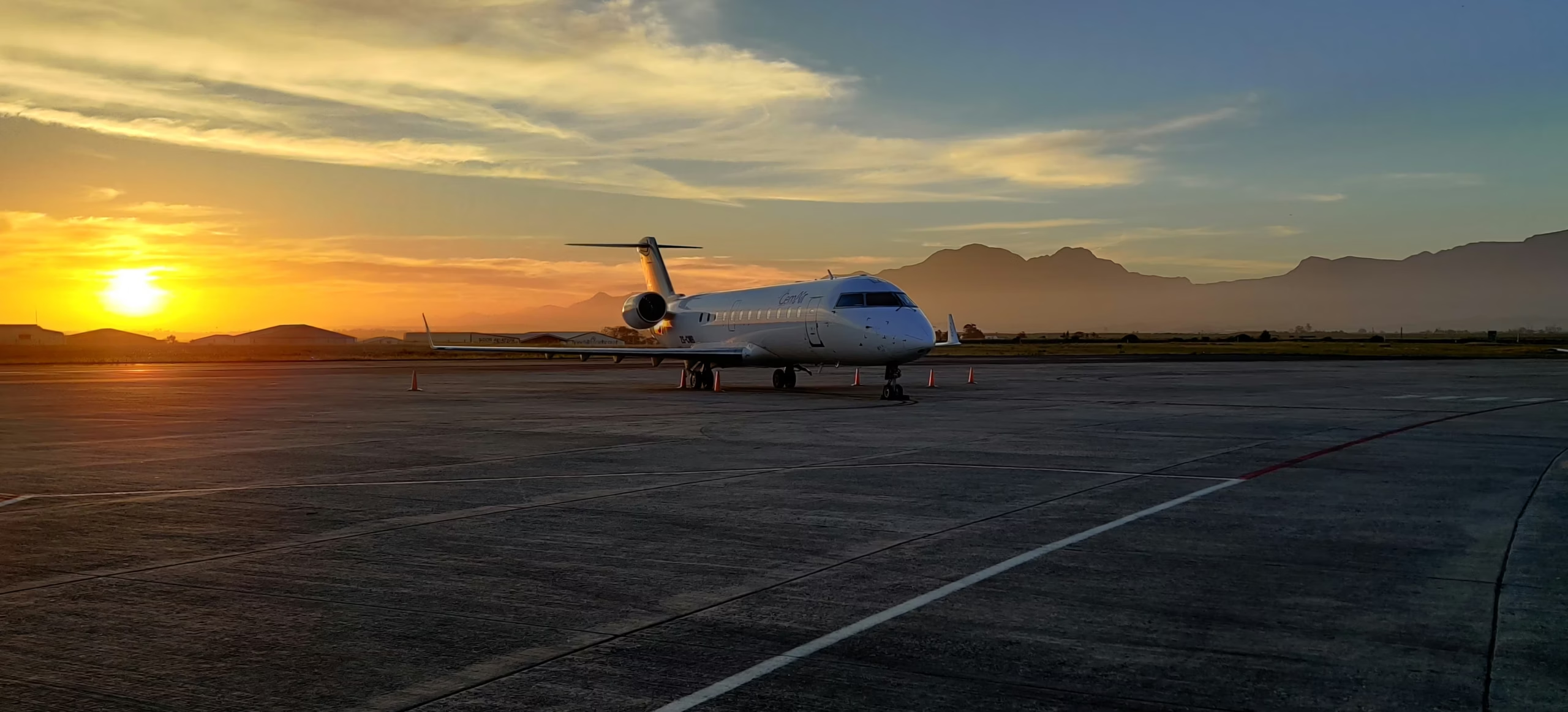
The global private aviation industry is undergoing one of the most fascinating transformations in its history.
For decades, private jet traffic revolved around predictable financial centers:
- New York,
- London,
- Geneva,
- Paris,
- and Los Angeles.
That world is changing rapidly.
A new geography of wealth is emerging.
And private aviation sits directly at the center of it.
Today, some of the fastest-growing aviation corridors globally involve:
- Dubai to Riyadh,
- Mumbai to Dubai,
- Singapore to Saudi Arabia,
- London to the UAE,
- Monaco to the Middle East,
- and India to Europe.
Why?
Because wealth itself has become increasingly mobile.
The modern ultra-high-net-worth individual no longer operates from a single city.
A family office may maintain:
- investments in London,
- operational teams in Dubai,
- manufacturing in India,
- banking in Singapore,
- and lifestyle assets in Europe.
Mobility therefore becomes infrastructure.
Not luxury.
This shift is dramatically reshaping private aviation demand.
According to multiple industry estimates, the global private aviation market is expected to cross hundreds of billions in economic activity over the next decade when including:
- charter services,
- aircraft management,
- FBO infrastructure,
- aviation technology,
- luxury mobility,
- maintenance ecosystems,
- and associated premium travel services.
But the real story is not the size of the industry.
The real story is behavioral change.
A new generation of wealthy individuals is entering the market.
These clients are:
- younger,
- more global,
- more entrepreneurial,
- more time-sensitive,
- and significantly more mobile than previous generations.
Unlike traditional industrial wealth, modern founders often operate internationally from day one.
This creates an entirely different relationship with mobility.
For many founders today, private aviation is not viewed emotionally as extravagance.
It is viewed operationally as leverage.
One private movement can save:
- 8 to 20 hours,
- multiple commercial connections,
- public exposure,
- and substantial scheduling inefficiencies.
Time compression has become one of the most important economic advantages in global business.
This is especially visible in the Middle East.
Dubai has emerged as one of the world’s most strategically important private aviation ecosystems because it connects:
- Europe,
- Asia,
- Africa,
- and the GCC.
The city functions almost like a global wealth transit layer.
And where wealth flows, luxury mobility follows naturally.
India is also becoming increasingly important.
The country’s rapid wealth creation is producing a new class of internationally mobile entrepreneurs.
Many Indian founders now operate globally while maintaining business interests across multiple continents.
This creates growing demand for:
- discreet mobility,
- business aviation,
- international charter access,
- and relationship-driven aviation ecosystems.
However, the industry still remains deeply fragmented.
This fragmentation creates both opportunity and risk.
Thousands of operators globally function with varying standards, capabilities, and operational sophistication.
For UHNW individuals and family offices, this creates one major challenge:
Whom do you trust?
This is precisely where the next generation of luxury mobility brands is emerging.
The future leaders in private aviation may not necessarily be companies owning the most aircraft.
They may instead become:
- intelligence layers,
- relationship ecosystems,
- operational trust networks,
- and global mobility orchestrators.
This is where Hype Luxury sees the future moving.
Because the future of private aviation is no longer simply about aircraft.
It is about:
- access,
- speed,
- privacy,
- reliability,
- and seamless global coordination.
The next decade of luxury mobility may therefore belong to brands capable of understanding one fundamental truth:
The world’s wealthiest individuals are not purchasing flights.
They are purchasing control over time itself.