

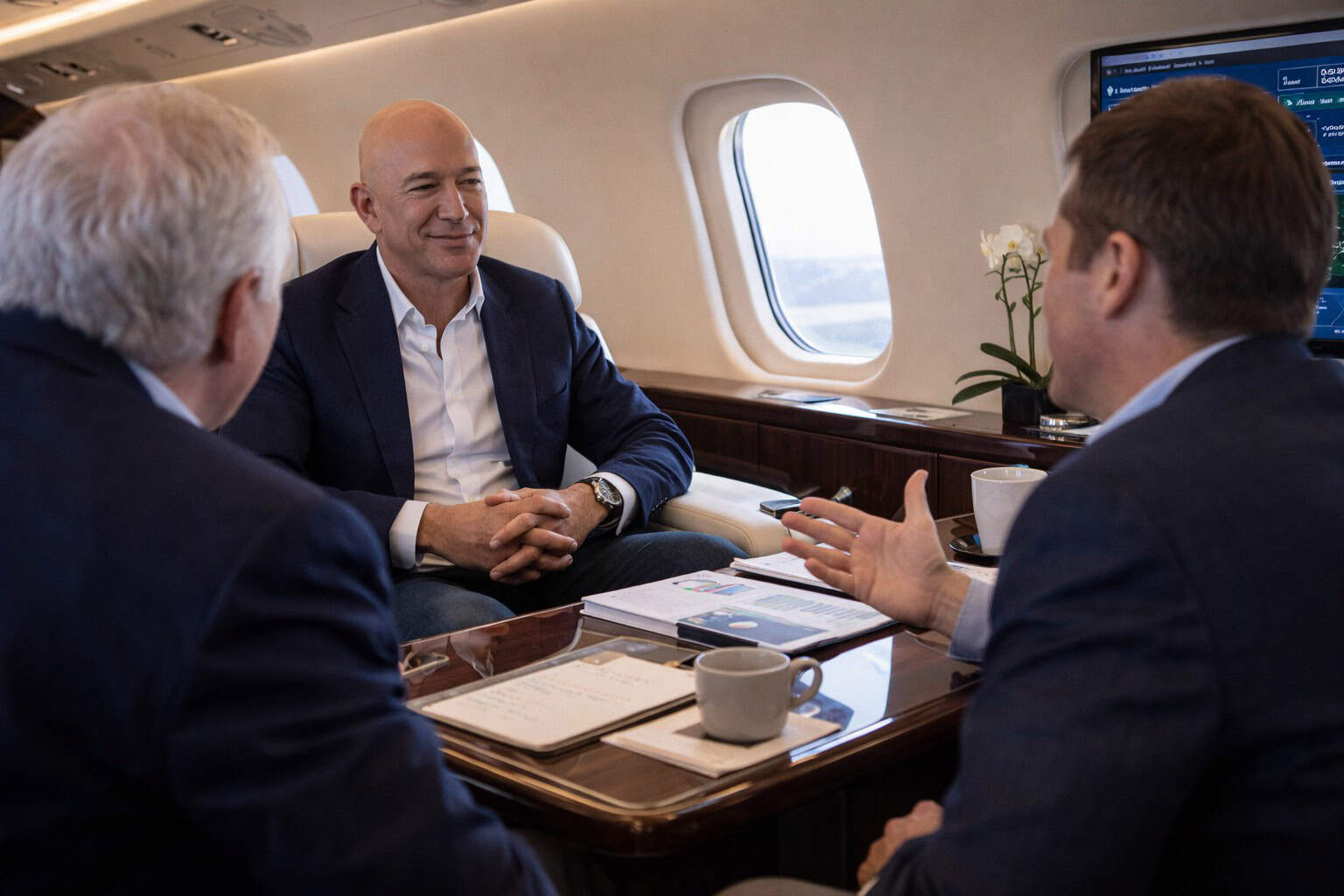
Jeff Bezos’ reported ownership of the Gulfstream G700 — manufactured by Gulfstream Aerospace — is not about indulgence. It is about infrastructure.
The G700 is among the most advanced long-range business jets ever built. With ultra-long-range capability connecting continents nonstop, multiple living zones, whisper-quiet cabins, and industry-leading avionics, it is designed for executives who operate globally — not occasionally, but constantly.
For someone whose ventures span space exploration, media, AI, logistics, and global investments, time compression becomes existential. Commercial aviation does not offer schedule sovereignty. Charter works — until operational frequency justifies ownership.
Ownership at this level becomes rational.
A G700 allows nonstop travel from New York to Dubai, London to Singapore, Los Angeles to Sydney — without compromise. It offers security, discretion, controlled crew, predictable availability, and tailored interior configuration aligned with work patterns.
More importantly, it converts travel time into productive time.
In ultra-high-net-worth strategy, there is a threshold where flexibility shifts from charter to ownership. When flight hours cross a certain mark annually, owning becomes operationally efficient. Capital is not being spent for optics — it is being deployed to protect velocity.
The aircraft becomes a mobile headquarters.
But beyond mechanics, there is signaling.
The G700 represents permanence. It communicates scale, longevity, and institutional presence. For leaders operating at planetary scope, mobility is not luxury — it is leverage.
Bezos does not own a G700 because he can.
He owns it because his ecosystem requires it.
At the highest levels of wealth, the question is never “Why so much?”
It is “Why not optimize everything?”