

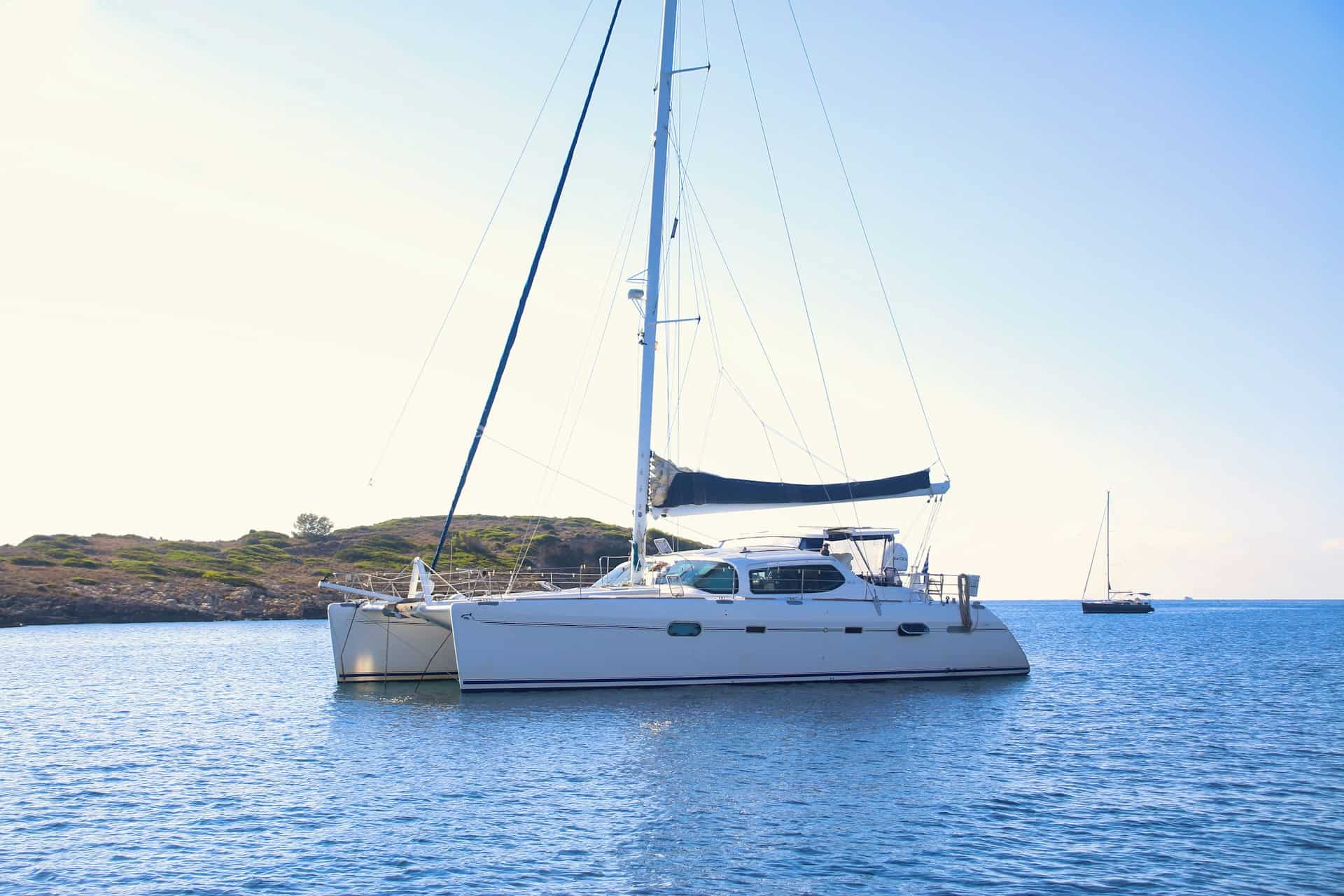
The most visually striking new arrivals at this year’s superyacht shows did not look like superyachts at all. They had two hulls, sometimes three, expansive flat decks the size of tennis courts, and a stance in the water more like a floating hotel than a traditional motor yacht. The multihull is no longer a niche of the sailing world. It is becoming a serious force in the upper reaches of luxury charter.
The reasons are practical, and they are reshaping the cruising map. A catamaran of a given length offers dramatically more usable deck space and interior volume than the equivalent monohull, because the beam — the width — is unconstrained by the physics of a single hull’s stability. A 30-metre catamaran feels closer to a 45-metre monohull in living space. The owner’s deck can be vast. The dining is alfresco on platforms that no monohull can match. The bow is a sun deck that doubles as a helicopter pad on the largest examples.
Even more consequential is the draft. Multihulls sit shallower in the water than equivalent monohulls, which means cruising grounds that were inaccessible to traditional superyachts open up. The Bahamas’ shallow banks. The thin water of the southern Maldives atolls. Parts of the Mediterranean’s east coast. Indonesia’s archipelagos. A catamaran can anchor where a monohull must lie offshore and send tenders ashore, transforming the guest experience in shallow-water destinations.
The motion characteristics matter too. At anchor, multihulls roll less than monohulls — a quality charter guests notice on the second morning, when they wake up rested rather than queasy. Underway, in moderate conditions, the ride is steadier across both hulls than the roll of a single hull. In heavy weather, the calculations become more complex and the experienced captain’s judgement matters more, but for the conditions in which the vast majority of charters operate, the multihull’s stability is a genuine asset.
The design vocabulary is finally catching up with the engineering case. Early luxury catamarans, frankly, looked like apartment buildings perched on hulls. The newest generation — from yards including Sunreef, Silent Yachts in the solar-electric category, and a growing list of mainstream builders developing power-catamaran lines — have resolved the aesthetic challenge with serious design language. Long, low profiles. Continuous flowing volumes. Interiors that compete with the best monohulls on craft and finish.
For the charter market, the implications are already visible. Charter brokers report rising demand for multihull options, particularly from families with young children — the stability and deck space are made for family use — and from groups travelling in destinations where shallow-water access is the headline feature. Charter rates remain competitive with equivalent monohulls, and in some cases below, because the multihull yards have been aggressive on pricing to grow the segment.
There are honest counter-arguments. Many seasoned yachting clients still prefer the classical lines of the monohull superyacht; the multihull aesthetic, however refined, is a different visual language. Berthing in tight Mediterranean harbours is more complicated for wider-beam vessels, which sometimes pay a Mediterranean stern-to penalty in port costs. And for outright top-end charter clients — the 80-metre, 100-metre principal yachts — the monohull will remain dominant for the foreseeable future.
But for the broader charter market — the 30 to 50-metre range that does the most weeks at sea — the multihull is moving from outlier to legitimate alternative. The yards order books reflect it. The brokers’ enquiries reflect it. And the destinations that suddenly find themselves accessible reflect it most of all.
The future of charter yachting will have two hulls more often than the past did. And the cruising map will be redrawn accordingly.