

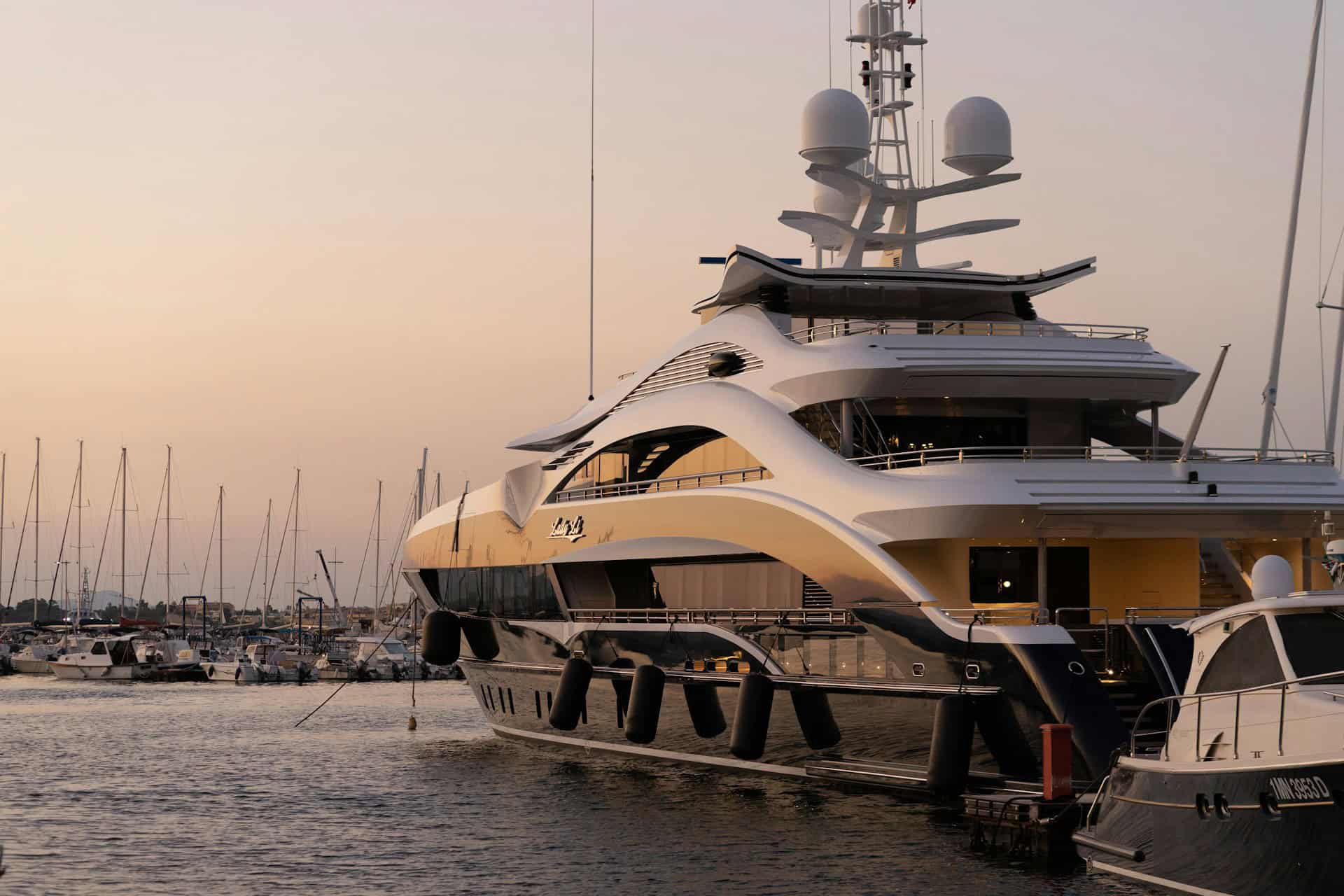
Somewhere off the Amalfi coast this summer, a chief executive will close a billion-dollar acquisition from a deck chair. The lawyers will be on Zoom from three time zones. The data room will sit on encrypted servers a continent away. The signature will happen on a tablet, between courses of lunch. And the office, throughout, will be a hundred-and-thirty-foot yacht moving at twelve knots.
This is no longer an outlier scene. The modern superyacht has quietly become one of the most strategic pieces of executive infrastructure in the world — a mobile headquarters where the world’s most powerful figures conduct business in conditions no land-based office can match.
The enabling technology arrived faster than most anticipated. Low-earth-orbit satellite connectivity, principally Starlink Maritime, has solved the connectivity problem that defined yachting for decades. Today’s chartered superyacht offers download speeds that embarrass most corporate headquarters, with full video conferencing, cloud access and encrypted communications standard. The yacht is no longer a place where work stops. It is a place where work continues, often better than ashore.
Security is the second pillar. For prominent executives, the conventional office is a porous environment — visitors, staff turnover, predictable schedules, hostile reconnaissance. A yacht in international waters or moored at a controlled berth is the opposite: a sealed environment with vetted crew, no walk-in traffic and complete control of the guest list. Sensitive board discussions, due diligence with acquisition targets, family-office strategy sessions — all happen with a degree of privacy no city office can guarantee.
Then there is the productivity dimension that no spreadsheet captures: the absence of interruption. The yacht eliminates the corporate hallway and its constant low-level traffic of unscheduled questions. A captain manages logistics. A crew handles hospitality. The executive’s day is reduced to its essentials — the meetings that matter, the deep work that requires uninterrupted thought, the relationships that need cultivation over dinner under the stars rather than across a conference table at lunch.
The format has produced its own playbook. Boards are held aboard for retreats with no leaks. Investor roadshows reposition the vessel from port to port, each anchorage a city. Family offices stage multi-generational summits at sea, away from staff and journalists. Even M&A teams now occasionally seal final negotiations on chartered yachts, treating the vessel as a neutral, secure venue that lawyers and bankers cannot easily replicate ashore.
The charter market has adapted. The most popular vessels for executive use share specific specifications: a dedicated office or convertible space with proper acoustics, full conferencing technology, sufficient owner-area privacy that crew and guests do not interrupt working hours, and itineraries built around connectivity windows and helicopter access for fast crew rotations.
The deeper logic, however, is human. The same wealth that built corner offices in the twentieth century learned, in the twenty-first, that the corner office is not the goal. The goal is the conditions for clear thinking — privacy, quiet, horizon. The superyacht, properly equipped, delivers all three in a way no land asset can.
The future of executive work, for those at the very top, will look less like the open-plan office and more like the open ocean. The boardroom is afloat. The view is unbeatable. And the company has never run more cleanly.