

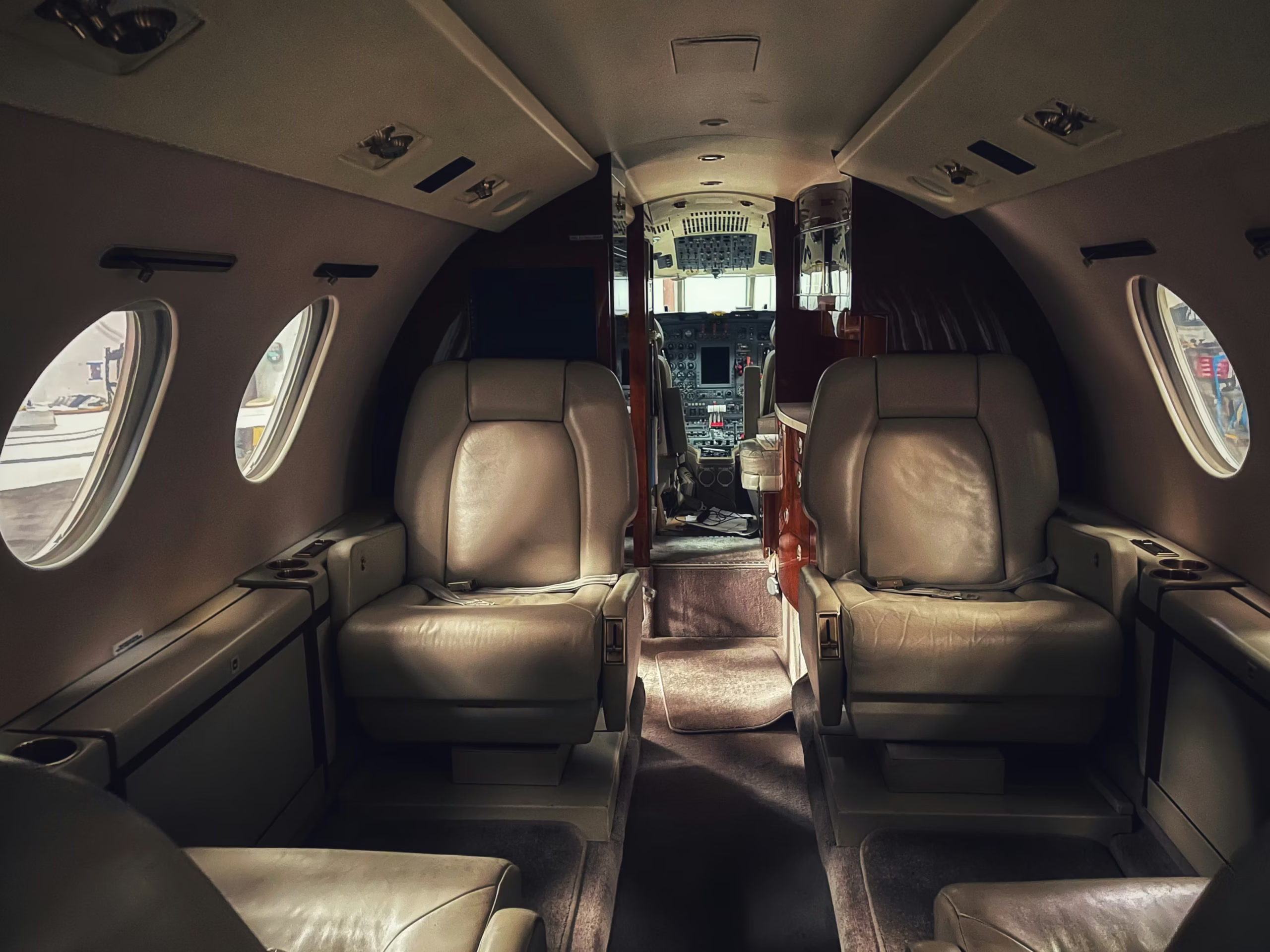
There is a number that never appears on a charter invoice. It has no line item, no VAT reference, no breakdown by hour. And yet it is, by any honest accounting, the most expensive thing a principal pays for when they step onto a private aircraft. That number is the cost of silence.
Silence, in the private aviation context, is not the absence of noise. It is the absence of consequence. The absence of a fellow passenger who recognises you. The absence of a leaked itinerary. The absence of a photograph taken in a departure lounge that surfaces forty-eight hours later on a financial news wire. The absence of a conversation overheard by someone who knew exactly what they were hearing.
When UHNW principals are asked why they fly privately, the answers given to researchers and journalists tend toward the practical: time efficiency, direct routings, the ability to land closer to a destination. These are real benefits. They are also, almost universally, not the primary driver. The primary driver is control over information — specifically, the information that their movement generates.
Every commercial flight a principal takes produces a data trail that is longer and more legible than most people appreciate. Booking records. Seat assignments. Lounge access logs. Passport scans at immigration. In jurisdictions with weaker data governance, these records leak. In jurisdictions with strong governance, they are still accessible to more parties than any serious principal would find acceptable. A commercial ticket is, in a very real sense, a declaration. It says: I am going here, at this time, for this duration.
Private aviation, managed properly, says nothing.
The key phrase is “managed properly.” Private aviation is not, by default, a privacy instrument. An aircraft booked through a retail charter platform, paid by a traceable corporate card, departing from a busy FBO with heavy foot traffic, is only marginally more discreet than a first-class cabin. The discretion is architectural — it has to be built into every layer of the process, from initial enquiry to ground handling to post-flight documentation.
This is where the gap between a broker and an advisor becomes material. A broker books a flight. An advisor constructs an information environment. The difference shows up in which FBO is selected and why. It shows up in how the booking is held — and under whose name. It shows up in crew briefings, ground transport sequencing, and the degree to which the tail number is, or is not, connected to any entity that would be interesting to a Bloomberg terminal.
Family offices are beginning to treat aviation privacy the way they treat cybersecurity: as infrastructure rather than a premium feature. The question is no longer whether to fly privately. It is whether the private flying being done has been properly designed as a privacy system. Most of it has not. Most of it has been purchased on a trip-by-trip basis from operators whose primary interest is seat utilisation, not principal protection.
The silence tax, then, is not a surcharge. It is the governing logic of every decision made on behalf of a principal in transit. It is the reason the right advisor costs what they cost, and the reason that cost is, for any principal whose movements carry market, political, or personal consequence, not optional.
Paying for a seat is easy. Paying for silence requires knowing who to trust.