

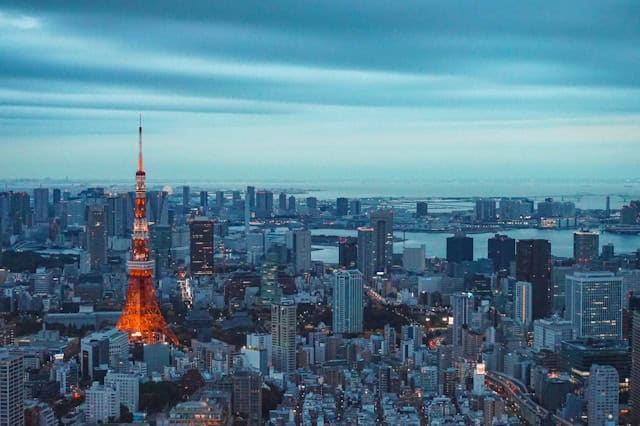
There is no luxury capital on earth that operates more quietly than Tokyo, and there is no UHNW client more demanding than the Japanese principal who has chosen, deliberately, to never be seen as such.
Japan’s wealthy operate on a code that the rest of the global luxury industry struggles to read. Inherited fortunes from the great trading houses, industrial families running multi-generational businesses, the post-war manufacturing dynasties, and increasingly a new wave of technology founders — together they constitute one of the largest concentrations of UHNW wealth in the world. And yet, walking through Ginza on a Tuesday evening, one would never know it. The wealthiest people in Japan have engineered their lives to be precisely as invisible as their cultural code requires.
This discretion is not modesty. It is a sophisticated luxury aesthetic with deep cultural roots. The Japanese concept of shibui — refined, understated, restrained beauty — operates as a default principle across how serious wealth presents itself. The brilliantly tailored navy suit. The wristwatch that costs more than most cars and signals nothing to the untrained eye. The chauffeured Toyota Century, never the Rolls-Royce, because the Century is the car that announces serious wealth in Japan precisely by its quietness.
For the luxury mobility industry, serving Japan well requires understanding what the rest of the world considers a contradiction. Japanese UHNW clients spend at the very top of the global market, but they almost never want to be visible doing it. The private aviation footprint out of Haneda and Narita is significant and growing, but the operators serving it succeed by being silent partners rather than branded presences. The luxury car culture exists at depth, but it expresses itself through restoration of vintage machines, bespoke modifications and quiet rotation rather than the showroom spectacle of Dubai or Los Angeles.
The yachting story is the most surprising for international observers. Japan has long been an exporter of luxury manufacturing and an importer of European yachting taste, but the domestic culture around boat ownership has remained limited compared to the country’s wealth profile. This is changing. A new generation of Japanese principals is increasingly engaging with the Mediterranean charter market, with Asian cruising grounds, and with bespoke commissions from European yards delivered for use in Japanese waters and beyond. The format that works for them is private and uncrowded — chartered yachts cruising less-trafficked areas, far from the social-scene yachting of Saint-Tropez or Porto Cervo.
Service expectations are a category of their own. The Japanese tradition of omotenashi — selfless hospitality that anticipates every need before it is articulated — sets a baseline of service that few international luxury operators can match in the principal’s home market. The Japanese client travelling abroad arrives with expectations shaped by domestic service that genuinely exceeds anything available in most of the global luxury industry. The operators who win their loyalty internationally are the ones who manage to deliver something approaching this standard while travelling.
The mobility patterns reflect Japan’s unique geography. Domestic private aviation routes — Tokyo to Hokkaido for the ski season, Tokyo to Okinawa for the winter escape, Tokyo to Kyoto for cultural visits — operate with high frequency among the wealthy. International routings concentrate on the well-established corridors to London, New York, Singapore and Hong Kong, with growing volume to Dubai as Gulf wealth and Japanese capital intersect.
At Hype Luxury, our engagement with Japanese clients is built on this understanding of the culture’s specific requirements. The brand presence is muted. The service is delivered through trusted relationships rather than marketing. The vehicles, yachts and aircraft are chosen for restraint as much as capability. And the discretion is total — what happens with a Japanese principal stays entirely between us.
The deeper lesson Tokyo teaches the global luxury industry is that loudness and luxury are not the same. The world’s most refined wealth culture has demonstrated, for a century, that the highest expression of luxury is its complete invisibility to anyone except those who already know to look. The brands that earn the right to serve Japan well learn this lesson, or they do not earn the right at all.
Tokyo is not catching up to global luxury. Global luxury is, slowly, catching up to Tokyo.