

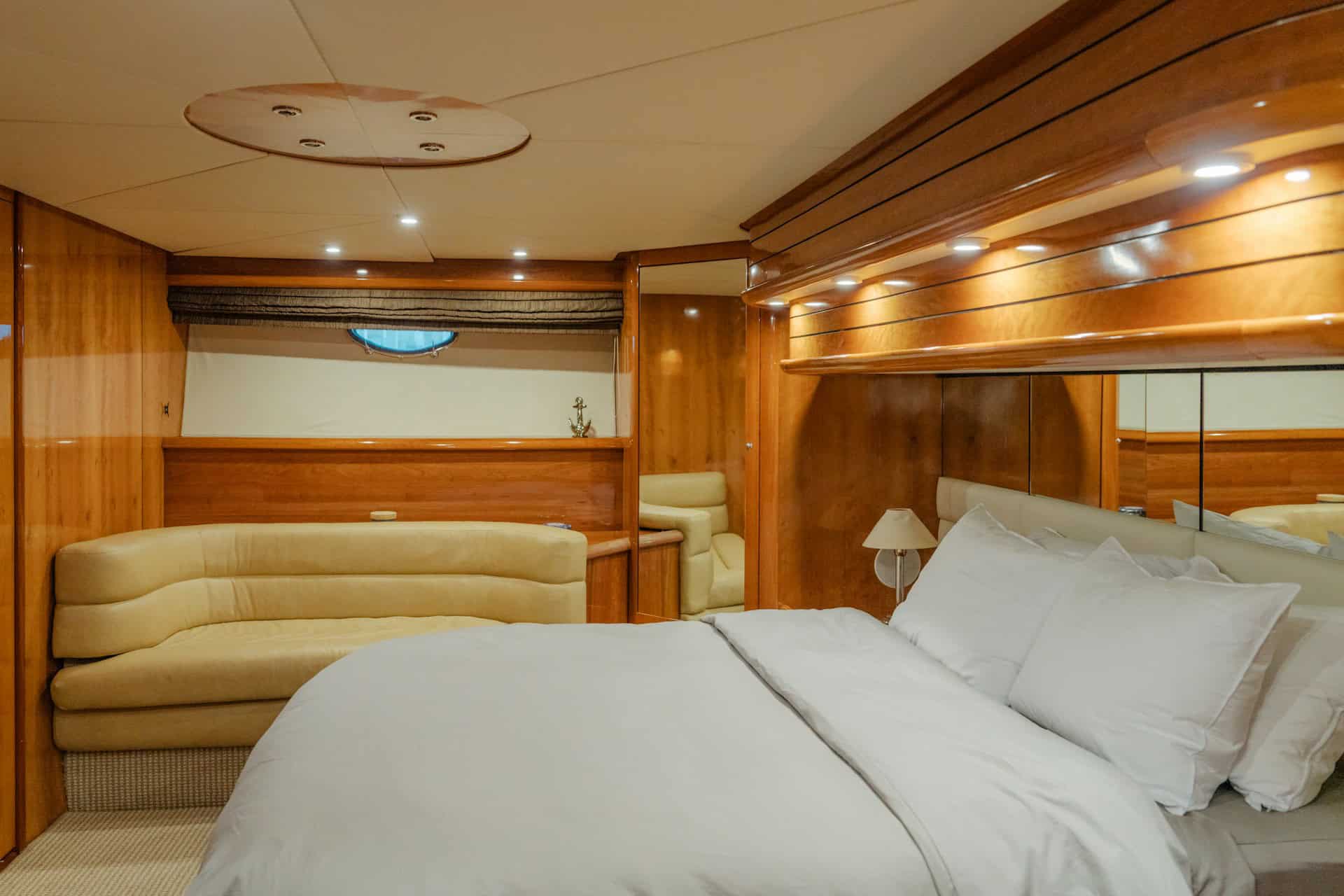
The private jet was long marketed on comfort — the seat, the catering, the wine, the space. The conversation that has quietly supplanted all of these in importance, among the most experienced private aviation clients, is sleep.
Not rest. Not recline. Sleep — the restorative, REM-cycling, physiologically effective sleep that allows a principal arriving in Tokyo after a 12-hour flight from London to walk into a board meeting at full cognitive capacity.
The Aircraft That Actually Delivers Sleep
Not all aircraft that claim sleeping configurations deliver genuine sleep quality. The critical variables are: flat-bed length (a minimum of 1.9 meters to accommodate most adults in a fully extended position), mattress quality (the finest operators supply memory foam or latex mattresses rather than seat cushion conversions), vibration isolation (a function of aircraft age, engine mounting, and fuselage design), noise levels (the Global 7500 and G700 both achieve approximately 52 decibels at cruise — the quietest in their class), and thermal control (cabin temperature independently controllable in sleeping zones).
The aircraft that genuinely delivers sleep: the Bombardier Global 7500 (dedicated bedroom suite with flat door and privacy partition), the Gulfstream G700 (dedicated aft suite in five-zone configuration), the Boeing BBJ 787 (master bedroom of genuine residential quality), and the Dassault Falcon 8X (exceptional noise profile for a large cabin aircraft).
The Circadian Lighting System
The most significant recent advancement in private aviation sleep science is not the bed — it is the lighting. Aircraft like the Global 7500 and the G700 feature programmable LED lighting systems that simulate natural light progression across the flight — gradually transitioning from the blue-spectrum light that suppresses melatonin production to the amber-spectrum light that signals the brain to prepare for sleep, timed to the destination’s local dawn.
A passenger on a London to Tokyo flight who begins this circadian lighting transition six hours before landing will arrive with their melatonin cycle partially pre-adjusted to Japanese time — a meaningful physiological advantage that no pharmaceutical jet lag remedy matches in efficacy or elegance.
Cabin Altitude: The Physiological Variable That Changes Everything
Standard pressurized aircraft maintain a cabin altitude equivalent to approximately 8,000 feet above sea level at cruise. At this altitude, blood oxygen saturation decreases by approximately 5-10% compared to sea level — contributing to the fatigue, headaches, and cognitive impairment that characterize long-haul travel.
The Boeing 787 Dreamliner’s composite fuselage allows cabin pressurization equivalent to 6,000 feet — a physiologically significant improvement that translates directly into less fatigue and better sleep quality. For clients who regularly travel ultra-long-haul and have noticed the difference between arriving on a 787 versus an older metal-fuselage aircraft, this variable is already understood intuitively.
The Pre-Sleep Protocol
The experienced private aviation client who optimizes for sleep quality on an overnight flight has a pre-sleep protocol: no alcohol within two hours of intended sleep onset (alcohol improves sleep onset but dramatically disrupts REM quality), magnesium supplementation (a vasodilator that improves sleep depth at altitude), noise-canceling headphones with binaural sleep audio rather than music or film, and the cabin temperature set to approximately 18 degrees celsius — the optimal sleep temperature for most adults.
At Hype Luxury, our pre-flight consultation includes sleep optimization guidance for clients on ultra-long-range bookings — because arriving ready is the point, and it requires preparation that begins before boarding.